Necrotizing fasciitis: Difference between revisions
No edit summary |
CSV import |
||
| Line 1: | Line 1: | ||
{{SI}} | |||
{{Infobox medical condition | |||
| name = Necrotizing fasciitis | |||
| image = [[File:Necrotizing_fasciitis_left_leg.JPEG|left|thumb|Severe case of necrotizing fasciitis on the left leg]] | |||
| caption = Severe case of necrotizing fasciitis on the left leg | |||
| field = [[Infectious disease]] | |||
| synonyms = Flesh-eating disease, flesh-eating bacteria syndrome | |||
| symptoms = [[Severe pain]], [[fever]], [[swelling]], [[redness]], [[fatigue]] | |||
| complications = [[Sepsis]], [[organ failure]], [[amputation]] | |||
| onset = Rapid, within hours to days | |||
| duration = Variable | |||
| causes = [[Bacterial infection]] (commonly [[Streptococcus pyogenes]], [[Staphylococcus aureus]]) | |||
| risks = [[Diabetes]], [[chronic disease]], [[immunosuppression]], [[alcoholism]], [[intravenous drug use]] | |||
| diagnosis = [[Medical imaging]], [[surgical exploration]], [[blood tests]] | |||
| differential = [[Cellulitis]], [[gas gangrene]], [[deep vein thrombosis]] | |||
| treatment = [[Surgical debridement]], [[antibiotics]], [[supportive care]] | |||
| prognosis = Variable, depends on severity and treatment | |||
| frequency = Rare | |||
| deaths = High mortality rate if untreated | |||
}} | |||
Necrotizing fasciitis is a serious infection of the skin, the tissue just beneath the skin (subcutaneous tissue), and the tissue that covers internal organs (fascia). | Necrotizing fasciitis is a serious infection of the skin, the tissue just beneath the skin (subcutaneous tissue), and the tissue that covers internal organs (fascia). | ||
[[File:Early symptoms of NF.jpg|thumb]] | [[File:Early symptoms of NF.jpg|left|thumb]] | ||
<youtube> | <youtube> | ||
title='''{{PAGENAME}}''' | title='''{{PAGENAME}}''' | ||
| Line 12: | Line 31: | ||
height=600 | height=600 | ||
</youtube> | </youtube> | ||
== '''Cause''' == | == '''Cause''' == | ||
Anyone can develop necrotizing fasciitis. The most common cause is '''group A Streptococcus'''. Other types of bacteria that can cause necrotizing fasciitis include '''Klebsiella, Clostridium, and Escherichia coli'''. | Anyone can develop necrotizing fasciitis. The most common cause is '''group A Streptococcus'''. Other types of bacteria that can cause necrotizing fasciitis include '''Klebsiella, Clostridium, and Escherichia coli'''. | ||
Approximately one-half of necrotizing fasciitis cases caused by streptococcal bacteria occur in young and otherwise healthy individuals. | Approximately one-half of necrotizing fasciitis cases caused by streptococcal bacteria occur in young and otherwise healthy individuals. | ||
== '''Transmission''' == | == '''Transmission''' == | ||
Although necrotizing fasciitis most frequently develops after trauma that causes a break in the skin, it can also develop after minor trauma that occurs without a break in the skin.Necrotizing fasciitis can occur as a complication of surgery; it can also occur at the site of a relatively minor injury such as an insect bite or an injection. In addition, underlying illnesses that weaken the immune system may increase the risk of necrotizing fasciitis.Some studies suggest a possible relationship between the use of [[nonsteroidal anti-inflammatory medications]] (NSAIDs) during [[varicella]] infections and the development of necrotizing fasciitis. | Although necrotizing fasciitis most frequently develops after trauma that causes a break in the skin, it can also develop after minor trauma that occurs without a break in the skin.Necrotizing fasciitis can occur as a complication of surgery; it can also occur at the site of a relatively minor injury such as an insect bite or an injection. In addition, underlying illnesses that weaken the immune system may increase the risk of necrotizing fasciitis.Some studies suggest a possible relationship between the use of [[nonsteroidal anti-inflammatory medications]] (NSAIDs) during [[varicella]] infections and the development of necrotizing fasciitis. | ||
The bacteria most commonly enter the body through a break in the skin, including: | The bacteria most commonly enter the body through a break in the skin, including: | ||
* Cuts and scrapes | * Cuts and scrapes | ||
| Line 27: | Line 43: | ||
* Surgical wounds | * Surgical wounds | ||
* However, people can also get necrotizing fasciitis after an injury that does not break the skin (blunt trauma). | * However, people can also get necrotizing fasciitis after an injury that does not break the skin (blunt trauma). | ||
== '''Symptoms''' == | == '''Symptoms''' == | ||
The infection often spreads very quickly. Early symptoms of necrotizing fasciitis can include: | The infection often spreads very quickly. Early symptoms of necrotizing fasciitis can include: | ||
| Line 33: | Line 48: | ||
* Severe pain, including pain beyond the area of the skin that is red, warm, or swollen | * Severe pain, including pain beyond the area of the skin that is red, warm, or swollen | ||
* Fever | * Fever | ||
Later symptoms of necrotizing fasciitis can include: | Later symptoms of necrotizing fasciitis can include: | ||
* Ulcers, blisters, or black spots on the skin | * Ulcers, blisters, or black spots on the skin | ||
| Line 41: | Line 55: | ||
* Fatigue (tiredness) | * Fatigue (tiredness) | ||
* Diarrhea or nausea | * Diarrhea or nausea | ||
== '''Diagnosis''' == | == '''Diagnosis''' == | ||
[[File:NFRTC 242 nevit.jpg|thumb]] | [[File:NFRTC 242 nevit.jpg|left|thumb]] | ||
There are many infections that look similar to necrotizing fasciitis in the early stages, which can make diagnosis difficult. In addition to looking at the injury or infection, doctors can diagnose necrotizing fasciitis by: | There are many infections that look similar to necrotizing fasciitis in the early stages, which can make diagnosis difficult. In addition to looking at the injury or infection, doctors can diagnose necrotizing fasciitis by: | ||
* Taking a tissue sample ([[biopsy]]) | * Taking a tissue sample ([[biopsy]]) | ||
* Looking at bloodwork for signs of infection and muscle damage | * Looking at bloodwork for signs of infection and muscle damage | ||
* Imaging ([[CT scan]], [[MRI]], [[ultrasound]]) of the damaged area. | * Imaging ([[CT scan]], [[MRI]], [[ultrasound]]) of the damaged area. | ||
== '''Treatment''' == | == '''Treatment''' == | ||
Accurate and prompt diagnosis, treatment with intravenous (IV) [[antibiotics]], and surgery to remove dead tissue are vital in treating necrotizing fasciitis. As the blood supply to the infected tissue becomes impaired, antibiotics often cannot penetrate the infected tissue. Therefore, surgery to remove the dead, damaged, or infected tissue is the primary treatment for necrotizing fasciitis. | Accurate and prompt diagnosis, treatment with intravenous (IV) [[antibiotics]], and surgery to remove dead tissue are vital in treating necrotizing fasciitis. As the blood supply to the infected tissue becomes impaired, antibiotics often cannot penetrate the infected tissue. Therefore, surgery to remove the dead, damaged, or infected tissue is the primary treatment for necrotizing fasciitis. | ||
Early surgery may minimize tissue loss, eliminating the need for amputation of the infected body part.The choice of antibiotics will likely depend on the particular bacteria involved. In addition, supplemental oxygen, fluids, and medicines may be needed to raise the blood pressure.[[Hyperbaric oxygen therapy]] and IV [[immunoglobulin]] may also be considered, but their use in patients with necrotizing fasciitis is controversial. | Early surgery may minimize tissue loss, eliminating the need for amputation of the infected body part.The choice of antibiotics will likely depend on the particular bacteria involved. In addition, supplemental oxygen, fluids, and medicines may be needed to raise the blood pressure.[[Hyperbaric oxygen therapy]] and IV [[immunoglobulin]] may also be considered, but their use in patients with necrotizing fasciitis is controversial. | ||
== '''Prognosis''' == | == '''Prognosis''' == | ||
If diagnosed and treated early, most patients will survive necrotizing fasciitis. If tissue loss is significant, skin grafting may be necessary. In some patients, amputation of the affected area is required. Up to 25% of patients will die from necrotizing fasciitis, due to complications such as kidney failure, blood poisoning (septicemia), and organ failure.The particular type of bacteria, the health of the patient, the location of the infection, and the speed of treatment can all influence the outcome. | If diagnosed and treated early, most patients will survive necrotizing fasciitis. If tissue loss is significant, skin grafting may be necessary. In some patients, amputation of the affected area is required. Up to 25% of patients will die from necrotizing fasciitis, due to complications such as kidney failure, blood poisoning (septicemia), and organ failure.The particular type of bacteria, the health of the patient, the location of the infection, and the speed of treatment can all influence the outcome. | ||
== '''Images''' == | == '''Images''' == | ||
<gallery widths="150" heights="200"> | <gallery widths="150" heights="200"> | ||
Revision as of 02:19, 9 April 2025

Editor-In-Chief: Prab R Tumpati, MD
Obesity, Sleep & Internal medicine
Founder, WikiMD Wellnesspedia &
W8MD's weight loss doctor NYC
Philadelphia GLP-1 weight loss and GLP-1 clinic NYC
| Necrotizing fasciitis | |
|---|---|
 | |
| Synonyms | Flesh-eating disease, flesh-eating bacteria syndrome |
| Pronounce | N/A |
| Specialty | N/A |
| Symptoms | Severe pain, fever, swelling, redness, fatigue |
| Complications | Sepsis, organ failure, amputation |
| Onset | Rapid, within hours to days |
| Duration | Variable |
| Types | N/A |
| Causes | Bacterial infection (commonly Streptococcus pyogenes, Staphylococcus aureus) |
| Risks | Diabetes, chronic disease, immunosuppression, alcoholism, intravenous drug use |
| Diagnosis | Medical imaging, surgical exploration, blood tests |
| Differential diagnosis | Cellulitis, gas gangrene, deep vein thrombosis |
| Prevention | N/A |
| Treatment | Surgical debridement, antibiotics, supportive care |
| Medication | N/A |
| Prognosis | Variable, depends on severity and treatment |
| Frequency | Rare |
| Deaths | High mortality rate if untreated |
Necrotizing fasciitis is a serious infection of the skin, the tissue just beneath the skin (subcutaneous tissue), and the tissue that covers internal organs (fascia).

Cause
Anyone can develop necrotizing fasciitis. The most common cause is group A Streptococcus. Other types of bacteria that can cause necrotizing fasciitis include Klebsiella, Clostridium, and Escherichia coli. Approximately one-half of necrotizing fasciitis cases caused by streptococcal bacteria occur in young and otherwise healthy individuals.
Transmission
Although necrotizing fasciitis most frequently develops after trauma that causes a break in the skin, it can also develop after minor trauma that occurs without a break in the skin.Necrotizing fasciitis can occur as a complication of surgery; it can also occur at the site of a relatively minor injury such as an insect bite or an injection. In addition, underlying illnesses that weaken the immune system may increase the risk of necrotizing fasciitis.Some studies suggest a possible relationship between the use of nonsteroidal anti-inflammatory medications (NSAIDs) during varicella infections and the development of necrotizing fasciitis. The bacteria most commonly enter the body through a break in the skin, including:
- Cuts and scrapes
- Burns
- Insect bites
- Puncture wounds (including those due to intravenous or IV drug use)
- Surgical wounds
- However, people can also get necrotizing fasciitis after an injury that does not break the skin (blunt trauma).
Symptoms
The infection often spreads very quickly. Early symptoms of necrotizing fasciitis can include:
- A red, warm, or swollen area of skin that spreads quickly
- Severe pain, including pain beyond the area of the skin that is red, warm, or swollen
- Fever
Later symptoms of necrotizing fasciitis can include:
- Ulcers, blisters, or black spots on the skin
- Changes in the color of the skin
- Pus or oozing from the infected area
- Dizziness
- Fatigue (tiredness)
- Diarrhea or nausea
Diagnosis

There are many infections that look similar to necrotizing fasciitis in the early stages, which can make diagnosis difficult. In addition to looking at the injury or infection, doctors can diagnose necrotizing fasciitis by:
- Taking a tissue sample (biopsy)
- Looking at bloodwork for signs of infection and muscle damage
- Imaging (CT scan, MRI, ultrasound) of the damaged area.
Treatment
Accurate and prompt diagnosis, treatment with intravenous (IV) antibiotics, and surgery to remove dead tissue are vital in treating necrotizing fasciitis. As the blood supply to the infected tissue becomes impaired, antibiotics often cannot penetrate the infected tissue. Therefore, surgery to remove the dead, damaged, or infected tissue is the primary treatment for necrotizing fasciitis.
Early surgery may minimize tissue loss, eliminating the need for amputation of the infected body part.The choice of antibiotics will likely depend on the particular bacteria involved. In addition, supplemental oxygen, fluids, and medicines may be needed to raise the blood pressure.Hyperbaric oxygen therapy and IV immunoglobulin may also be considered, but their use in patients with necrotizing fasciitis is controversial.
Prognosis
If diagnosed and treated early, most patients will survive necrotizing fasciitis. If tissue loss is significant, skin grafting may be necessary. In some patients, amputation of the affected area is required. Up to 25% of patients will die from necrotizing fasciitis, due to complications such as kidney failure, blood poisoning (septicemia), and organ failure.The particular type of bacteria, the health of the patient, the location of the infection, and the speed of treatment can all influence the outcome.
Images
-
 The very first symptom of NF. The center is clearly getting darker red (purple).
 -
 Early symptoms of necrotizing fasciitis. The darker red center is going black.
 -
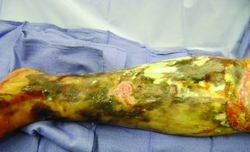 Necrotizing fasciitis type III caused by vibrio vulnificus.


 | |
|---|---|
 |
 |
| Soft tissue disorders | ||||||||||||||||||||
|---|---|---|---|---|---|---|---|---|---|---|---|---|---|---|---|---|---|---|---|---|
|
