Köhler disease
| Köhler disease | |
|---|---|
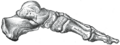
| Gray290.png | |
| Skeleton of foot. Medial aspect. | |
| Synonyms | Aseptic necrosis of the tarsal bone, Kohler's Disease of the Tarsal Navicular, Osteochondritis of tarsal/metatarsal bone
|
| Specialty | Orthopedics
|
| Usual onset | 6-9 years old
|
| Treatment | Below knee cast, rest, NSAIDs, analgesics
|
| Prognosis | Good, with very few complications if treated
|
Other names[edit]
Kohler's Disease; Kohler's Disease of the Tarsal Navicular; Kohler's Osteochondrosis of the Tarsal Navicular;
Clinical features[edit]
Kohler disease is a condition that affects a bone at the arch of the foot called the tarsal navicular bone. X-rays show that this bone is initially compressed and later breaks into pieces before healing and hardening back into bone. It occurs most frequently in children between the ages of 5 and 10 years.
Signs and symptoms[edit]
Signs and symptoms of the condition include swelling, redness and/or tenderness of the affected foot which can lead to a limp or abnormal gait (style of walking). Although the exact underlying cause of Kohler disease is unknown, some scientists suspect that it may be caused by excessive strain on the tarsal navicular bone and its associated blood vessels before the bone is completely ossified (hardened). The condition typically resolves on its own with or without treatment; however, pain relievers, rest, avoidance of weight-bearing activities, and/or casting may be recommended to help manage symptoms.
Symptoms[edit]
- The signs and symptoms of Kohler disease vary, but may include:
- Swelling of the foot
- Redness of the affected area
- Tenderness, particularly along the length of the arch
- Limp or abnormal gait (style of walking)
- Symptoms may worsen if weight is put on the affected foot, which can make walking painful and difficult.
Do you have updated information on this disease? We want to hear from you.
Cause[edit]
The exact underlying cause of Kohler disease is unknown. However, some scientists suspect that it may be caused by excessive strain on a certain bone of the foot (tarsal navicular bone) and its associated blood vessels before the bone is completely ossified (hardened).
Bone ossification usually begins at age 18-24 months in girls and at age 24 to 30 months in boys. As the child grows, their foot is required to support more weight. Ossification of the tarsal navicular bone often occurs more slowly than the other bones of the foot. Consequently, surrounding bones may compress it and its blood vessels resulting in osteonecrosis and ischemia (a loss of blood supply).
Inheritance[edit]
The exact underlying cause of Kohler disease is currently unknown. Although some scientists have suggested that genetic factors may play a role in the development of Kohler disease, no disease-causing gene has been identified.
Diagnosis[edit]
A diagnosis of Kohler disease is suspected based on the presence of characteristic signs and symptoms. An x-ray of the foot can be used to confirm the diagnosis and evaluate the progression of the condition.
Treatment[edit]
Kohler disease typically resolves over time with or without treatment. However, pain relievers, rest and avoidance of weight-bearing activities can help alleviate some of the symptoms. In some cases, a plaster walking cast and/or arch supports may also be recommended.
Prognosis[edit]
The long-term outlook (prognosis) for people with Kohler disease is usually excellent. Symptoms can last from a few days to two years; however, most cases resolve within a year. People affected by the condition typically recover all function of the affected foot and have no lasting consequences.
| Bone and joint disease | ||||||||||||||||||||
|---|---|---|---|---|---|---|---|---|---|---|---|---|---|---|---|---|---|---|---|---|
|
NIH genetic and rare disease info[edit]
Köhler disease is a rare disease.
| Rare and genetic diseases | ||||||
|---|---|---|---|---|---|---|
|
Rare diseases - Köhler disease
|
-
 Köhler disease


Medical Disclaimer: WikiMD is for informational purposes only and is not a substitute for professional medical advice. Content may be inaccurate or outdated and should not be used for diagnosis or treatment. Always consult your healthcare provider for medical decisions. Verify information with trusted sources such as CDC.gov and NIH.gov. By using this site, you agree that WikiMD is not liable for any outcomes related to its content. See full disclaimer.
Credits:Most images are courtesy of Wikimedia commons, and templates, categories Wikipedia, licensed under CC BY SA or similar.
Translate page: - East Asian
中文,
日本,
한국어,
South Asian
हिन्दी,
தமிழ்,
తెలుగు,
Urdu,
ಕನ್ನಡ,
Southeast Asian
Indonesian,
Vietnamese,
Thai,
မြန်မာဘာသာ,
বাংলা
European
español,
Deutsch,
français,
Greek,
português do Brasil,
polski,
română,
русский,
Nederlands,
norsk,
svenska,
suomi,
Italian
Middle Eastern & African
عربى,
Turkish,
Persian,
Hebrew,
Afrikaans,
isiZulu,
Kiswahili,
Other
Bulgarian,
Hungarian,
Czech,
Swedish,
മലയാളം,
मराठी,
ਪੰਜਾਬੀ,
ગુજરાતી,
Portuguese,
Ukrainian

