Human eye
Human eye
The Human eye is a complex organ that provides visual perception, enabling humans to interpret the surrounding environment by processing light. It is part of the sensory system and is crucial for most forms of visual communication.
Anatomy[edit]
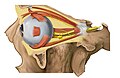
The human eye is roughly spherical and is composed of several key components:
- Cornea: The transparent front part of the eye that covers the iris, pupil, and anterior chamber.
- Iris: The thin, circular structure in the eye that controls the diameter and size of the pupil and thus the amount of light reaching the retina.
- Pupil: The black circular opening in the iris that lets light in.
- Lens: The transparent biconvex structure in the eye that helps to refract light to be focused on the retina.
- Retina: The light-sensitive layer of tissue at the back of the inner eye that translates light into electrical signals.
Function[edit]
The human eye functions by refracting light to be focused on the retina, where it is converted into electrical signals that are sent to the brain via the optic nerve. This process, known as visual perception, allows humans to interpret the surrounding environment.
Health and disease[edit]
There are numerous diseases and conditions that can affect the human eye, including cataract, glaucoma, macular degeneration, and diabetic retinopathy. Regular eye examinations are recommended to detect these conditions early and initiate treatment.
See also[edit]
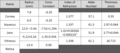
| Anatomy of the globe of the human eye | ||||||||||||||||||
|---|---|---|---|---|---|---|---|---|---|---|---|---|---|---|---|---|---|---|
|
| Visual perception | ||||||||||
|---|---|---|---|---|---|---|---|---|---|---|
This Visual perception related article is a stub.
|

-
 Human_eye
 -
 Human_eye
 -
 Human_eye
 -
 Human_eye
 -
 Human_eye
 -
 Human_eye
 -
 Human_eye
 -
 Human_eye
 -
 Human_eye
 -
 Human_eye
 -
 Human_eye
 -
 Human_eye


Ad. Transform your health with W8MD Weight Loss, Sleep & MedSpa

Tired of being overweight?
Special offer:
Budget GLP-1 weight loss medications
- Semaglutide starting from $29.99/week and up with insurance for visit of $59.99 and up per week self pay.
- Tirzepatide starting from $45.00/week and up (dose dependent) or $69.99/week and up self pay
✔ Same-week appointments, evenings & weekends
Learn more:
- GLP-1 weight loss clinic NYC
- W8MD's NYC medical weight loss
- W8MD Philadelphia GLP-1 shots
- Philadelphia GLP-1 injections
- Affordable GLP-1 shots NYC
|
WikiMD Medical Encyclopedia |
Medical Disclaimer: WikiMD is for informational purposes only and is not a substitute for professional medical advice. Content may be inaccurate or outdated and should not be used for diagnosis or treatment. Always consult your healthcare provider for medical decisions. Verify information with trusted sources such as CDC.gov and NIH.gov. By using this site, you agree that WikiMD is not liable for any outcomes related to its content. See full disclaimer.
Credits:Most images are courtesy of Wikimedia commons, and templates, categories Wikipedia, licensed under CC BY SA or similar.
Translate this page: - East Asian
中文,
日本,
한국어,
South Asian
हिन्दी,
தமிழ்,
తెలుగు,
Urdu,
ಕನ್ನಡ,
Southeast Asian
Indonesian,
Vietnamese,
Thai,
မြန်မာဘာသာ,
বাংলা
European
español,
Deutsch,
français,
Greek,
português do Brasil,
polski,
română,
русский,
Nederlands,
norsk,
svenska,
suomi,
Italian
Middle Eastern & African
عربى,
Turkish,
Persian,
Hebrew,
Afrikaans,
isiZulu,
Kiswahili,
Other
Bulgarian,
Hungarian,
Czech,
Swedish,
മലയാളം,
मराठी,
ਪੰਜਾਬੀ,
ગુજરાતી,
Portuguese,
Ukrainian
