Optic cup (anatomical)
The Optic Cup is a two-layered structure formed during the embryonic development of the eye in vertebrates, including humans. It plays a crucial role in the formation of the retina, the light-sensitive tissue lining the inner surface of the eye.
Structure[edit]
The Optic Cup is derived from the Optic Vesicle, an outpouching of the diencephalon that occurs during the third week of embryonic development. The Optic Vesicle invaginates to form the Optic Cup, which consists of an outer pigmented layer and an inner neural layer.
The outer pigmented layer of the Optic Cup gives rise to the retinal pigment epithelium, which plays a vital role in visual function by absorbing excess light and providing metabolic support to the photoreceptor cells. The inner neural layer of the Optic Cup differentiates into the neural retina, which contains the photoreceptor cells that convert light into electrical signals.
Development[edit]
The development of the Optic Cup is a complex process that involves a series of morphological changes and is regulated by various genetic factors. The transformation of the Optic Vesicle into the Optic Cup is driven by the process of invagination, which is influenced by interactions between the Optic Vesicle and the overlying surface ectoderm.
The formation of the Optic Cup is also associated with the establishment of the optic stalk, which serves as a conduit for the optic nerve fibers connecting the eye to the brain.
Clinical significance[edit]
Abnormalities in the formation of the Optic Cup can lead to various eye disorders, including microphthalmia (small eyes), anophthalmia (absence of the eye), and coloboma (a gap in the eye structure), among others. These conditions can result in visual impairment or blindness.
See also[edit]
References[edit]

Optic cup (anatomical)[edit]
-
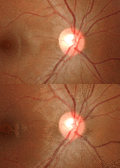 3D motion parallax of optic cup and macula


Medical Disclaimer: WikiMD is for informational purposes only and is not a substitute for professional medical advice. Content may be inaccurate or outdated and should not be used for diagnosis or treatment. Always consult your healthcare provider for medical decisions. Verify information with trusted sources such as CDC.gov and NIH.gov. By using this site, you agree that WikiMD is not liable for any outcomes related to its content. See full disclaimer.
Credits:Most images are courtesy of Wikimedia commons, and templates, categories Wikipedia, licensed under CC BY SA or similar.
Translate page: - East Asian
中文,
日本,
한국어,
South Asian
हिन्दी,
தமிழ்,
తెలుగు,
Urdu,
ಕನ್ನಡ,
Southeast Asian
Indonesian,
Vietnamese,
Thai,
မြန်မာဘာသာ,
বাংলা
European
español,
Deutsch,
français,
Greek,
português do Brasil,
polski,
română,
русский,
Nederlands,
norsk,
svenska,
suomi,
Italian
Middle Eastern & African
عربى,
Turkish,
Persian,
Hebrew,
Afrikaans,
isiZulu,
Kiswahili,
Other
Bulgarian,
Hungarian,
Czech,
Swedish,
മലയാളം,
मराठी,
ਪੰਜਾਬੀ,
ગુજરાતી,
Portuguese,
Ukrainian

