Ciliary muscle


Muscle in the eye
[[File: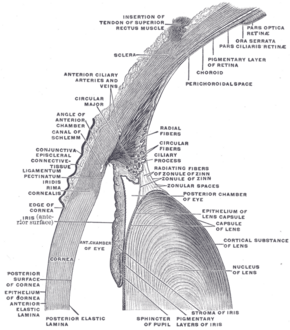 |frameless|alt=]]

| Details | |
|---|---|
| Synonyms | |
| Pronunciation | |
| Carnegie stage | |
| Days | |
| Precursor | |
| Gives rise to | |
| Part of | |
The ciliary muscle is a ring of smooth muscle in the eye's middle layer, known as the uvea. It controls accommodation for viewing objects at varying distances and regulates the flow of aqueous humor into Schlemm's canal. The ciliary muscle changes the shape of the lens within the eye, which is essential for focusing on near and distant objects.
Structure[edit]
The ciliary muscle is composed of both longitudinal and circular fibers. The longitudinal fibers are attached to the sclera and the choroid, while the circular fibers are arranged concentrically around the lens. The muscle is innervated by the oculomotor nerve, specifically the parasympathetic fibers from the Edinger-Westphal nucleus.
Function[edit]
The primary function of the ciliary muscle is to control the shape of the lens. When the ciliary muscle contracts, it releases tension on the zonular fibers, allowing the lens to become more convex, which is necessary for focusing on close objects. This process is known as accommodation. Conversely, when the ciliary muscle relaxes, the zonular fibers become taut, flattening the lens and allowing the eye to focus on distant objects.
Clinical significance[edit]
Dysfunction of the ciliary muscle can lead to various eye diseases and conditions. For instance, presbyopia is an age-related condition where the ciliary muscle loses its ability to contract effectively, resulting in difficulty focusing on close objects. Additionally, abnormalities in the ciliary muscle can affect the flow of aqueous humor, potentially leading to glaucoma.
See also[edit]
References[edit]

 | This medical article is a stub. You can help WikiMD by expanding the page. |

Medical Disclaimer: WikiMD is for informational purposes only and is not a substitute for professional medical advice. Content may be inaccurate or outdated and should not be used for diagnosis or treatment. Always consult your healthcare provider for medical decisions. Verify information with trusted sources such as CDC.gov and NIH.gov. By using this site, you agree that WikiMD is not liable for any outcomes related to its content. See full disclaimer.
Credits:Most images are courtesy of Wikimedia commons, and templates, categories Wikipedia, licensed under CC BY SA or similar.
Translate page: - East Asian
中文,
日本,
한국어,
South Asian
हिन्दी,
தமிழ்,
తెలుగు,
Urdu,
ಕನ್ನಡ,
Southeast Asian
Indonesian,
Vietnamese,
Thai,
မြန်မာဘာသာ,
বাংলা
European
español,
Deutsch,
français,
Greek,
português do Brasil,
polski,
română,
русский,
Nederlands,
norsk,
svenska,
suomi,
Italian
Middle Eastern & African
عربى,
Turkish,
Persian,
Hebrew,
Afrikaans,
isiZulu,
Kiswahili,
Other
Bulgarian,
Hungarian,
Czech,
Swedish,
മലയാളം,
मराठी,
ਪੰਜਾਬੀ,
ગુજરાતી,
Portuguese,
Ukrainian

