Familial exudative vitreoretinopathy
| Familial exudative vitreoretinopathy | |
|---|---|

| |
| Synonyms | FEVR (initialism), Criswick-Schepens syndrome |
| Pronounce | (initialism) |
| Field | |
| Symptoms | |
| Complications | |
| Onset | |
| Duration | |
| Types | |
| Causes | |
| Risks | |
| Diagnosis | |
| Differential diagnosis | |
| Prevention | |
| Treatment | |
| Medication | |
| Prognosis | |
| Frequency | |
| Deaths | |
Familial exudative vitreoretinopathy (FEVR, pronounced as fever) is a genetic disorder affecting the growth and development of blood vessels in the retina of the eye.<ref name="pmid20738858">Shastry BS,
 Genetic susceptibility to advanced retinopathy of prematurity (ROP),
 J. Biomed. Sci.,
 2010,
 Vol. 17,
 pp. 69,
 DOI: 10.1186/1423-0127-17-69,
 PMID: 20738858,
 PMC: 2933676,</ref>  This disease can lead to visual impairment and sometimes complete blindness in one or both eyes.  FEVR is characterized by exudative leakage and hemorrhage of the blood vessels in the retina, along with incomplete vascularization of the peripheral retina.  The disease process can lead to retinal folds, tears, and detachments.
Causes
Genetic types include:
| Type | OMIM | Gene | Locus |
|---|---|---|---|
| EVR1 | Template:OMIM2 | FZD4 | 11q14-q21 |
| EVR2 | Template:OMIM2 | NDP | Xp11.4 |
| EVR3 | Template:OMIM2 | ? (exact gene unknown) | 11p13-p12 |
| EVR4 | Template:OMIM2 | LRP5 | 11q13.4 |
| EVR5 | Template:OMIM2 | TSPAN12 | 7q31 |
| EVR6 | Template:OMIM2 | ZNF408 | 11p11.2 |
| EVR7 | Template:OMIM2 | CTNNB1 | 3p22.1 |
References
External links
- GeneReviews/NCBI/NIH/UW entry on Familial Exudative Vitreoretinopathy, Autosomal Dominant
- NCBI Genetic Testing Registry
| Congenital malformations and deformations of eyes | ||||
|---|---|---|---|---|
|
| Cell membrane protein disorders (other than Cell surface receptor, enzymes, and cytoskeleton) | ||||||||||
|---|---|---|---|---|---|---|---|---|---|---|
See also other cell membrane proteins
|

-
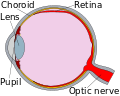 Cross section of human eye with detached retina
 -
Grayscale cross-sectional view of human eye
-
 Photocoagulation procedure illustration


Ad. Transform your life with W8MD's
GLP-1 weight loss injections special from $29.99 with insurance
|
WikiMD Medical Encyclopedia |
Medical Disclaimer: WikiMD is for informational purposes only and is not a substitute for professional medical advice. Content may be inaccurate or outdated and should not be used for diagnosis or treatment. Always consult your healthcare provider for medical decisions. Verify information with trusted sources such as CDC.gov and NIH.gov. By using this site, you agree that WikiMD is not liable for any outcomes related to its content. See full disclaimer.
Credits:Most images are courtesy of Wikimedia commons, and templates, categories Wikipedia, licensed under CC BY SA or similar.
Translate this page: - East Asian
中文,
日本,
한국어,
South Asian
हिन्दी,
தமிழ்,
తెలుగు,
Urdu,
ಕನ್ನಡ,
Southeast Asian
Indonesian,
Vietnamese,
Thai,
မြန်မာဘာသာ,
বাংলা
European
español,
Deutsch,
français,
Greek,
português do Brasil,
polski,
română,
русский,
Nederlands,
norsk,
svenska,
suomi,
Italian
Middle Eastern & African
عربى,
Turkish,
Persian,
Hebrew,
Afrikaans,
isiZulu,
Kiswahili,
Other
Bulgarian,
Hungarian,
Czech,
Swedish,
മലയാളം,
मराठी,
ਪੰਜਾਬੀ,
ગુજરાતી,
Portuguese,
Ukrainian

