Receptor tyrosine kinase
Receptor tyrosine kinase (RTK) is a high-affinity cell surface receptor for many polypeptide growth factors, cytokines, and hormones. Of the 90 unique tyrosine kinase genes identified in the human genome, 58 encode receptor tyrosine kinase proteins.
Structure[edit]
RTKs are single-pass transmembrane proteins. They share a common structural design with a ligand-binding extracellular domain, a single transmembrane helix, and an intracellular region that contains a protein tyrosine kinase domain flanked by regulatory elements.
Function[edit]
RTKs play a critical role in cellular communication, controlling cell growth, differentiation, metabolism, and migration. They are key regulators of normal cellular processes but can also promote cancer development and progression if mutated or overexpressed.
Classification[edit]
RTKs are classified into 20 subfamilies based on their structural characteristics and sequence homology. These include the EGFR (epidermal growth factor receptor) family, the Insulin receptor family, and the VEGFR (vascular endothelial growth factor receptor) family, among others.
Role in Disease[edit]
Dysregulation of RTK signaling pathways plays a critical role in the development of cancer. Mutations in RTK genes can lead to overexpression of the receptor, or cause the receptor to be constantly activated, even in the absence of growth factors.
Therapeutic Target[edit]
Because of their critical role in cancer, RTKs have become important targets for cancer therapy. Several drugs that target RTKs have been approved for use in cancer treatment, including Gefitinib for non-small cell lung cancer and Trastuzumab for breast cancer.

 | This medical article is a stub. You can help WikiMD by expanding the page. |
Receptor tyrosine kinase gallery[edit]
-
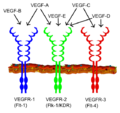 VEGF receptors
 -
Phosphate anion
-
 ATP structure
 -
 L-Tyrosine
 -
 O-Phospho-L-tyrosine


Medical Disclaimer: WikiMD is for informational purposes only and is not a substitute for professional medical advice. Content may be inaccurate or outdated and should not be used for diagnosis or treatment. Always consult your healthcare provider for medical decisions. Verify information with trusted sources such as CDC.gov and NIH.gov. By using this site, you agree that WikiMD is not liable for any outcomes related to its content. See full disclaimer.
Credits:Most images are courtesy of Wikimedia commons, and templates, categories Wikipedia, licensed under CC BY SA or similar.
Translate page: - East Asian
中文,
日本,
한국어,
South Asian
हिन्दी,
தமிழ்,
తెలుగు,
Urdu,
ಕನ್ನಡ,
Southeast Asian
Indonesian,
Vietnamese,
Thai,
မြန်မာဘာသာ,
বাংলা
European
español,
Deutsch,
français,
Greek,
português do Brasil,
polski,
română,
русский,
Nederlands,
norsk,
svenska,
suomi,
Italian
Middle Eastern & African
عربى,
Turkish,
Persian,
Hebrew,
Afrikaans,
isiZulu,
Kiswahili,
Other
Bulgarian,
Hungarian,
Czech,
Swedish,
മലയാളം,
मराठी,
ਪੰਜਾਬੀ,
ગુજરાતી,
Portuguese,
Ukrainian


