Terri Schiavo case
The case of Terri Schiavo was a landmark legal and ethical dispute in the United States that centered around issues of end-of-life care, patients' rights, and guardianship. Theresa Marie "Terri" Schiavo (December 3, 1963 – March 31, 2005) was a woman from Florida who entered a Persistent Vegetative State (PVS) following a cardiac arrest in 1990, which resulted in severe brain damage due to lack of oxygen.
Background and Medical Condition[edit]
On February 25, 1990, Terri Schiavo collapsed in her home from cardiac arrest, likely caused by a potassium imbalance. The oxygen supply to her brain was cut off for several minutes, causing extensive brain damage. Despite multiple therapies and interventions, Schiavo remained in a PVS, characterized by periods of wakefulness but without awareness or meaningful response to her environment.
Legal Dispute and Public Controversy[edit]
The legal battle began in 1998 when Michael Schiavo, Terri's husband and legal guardian, petitioned the Sixth Circuit Court of Florida to remove her feeding tube, asserting that Terri would not have wanted to live in a PVS. Terri's parents, Robert and Mary Schindler, opposed the removal, arguing that their daughter was conscious and could recover with therapy.
The case became a highly publicized media event, sparking nationwide debates over end-of-life care, patients' rights, euthanasia, and disability rights. Several court rulings, appeals, and legislative interventions occurred over seven years, with the feeding tube being removed and reinserted multiple times.
Resolution and Aftermath[edit]
In 2005, after numerous court rulings and appeals, the U.S. Supreme Court declined to hear the case, allowing a previous court order for the removal of the feeding tube to stand. Terri Schiavo died on March 31, 2005, thirteen days after the feeding tube was removed for the final time.
The case had lasting effects on public discourse and legislation related to end-of-life care. It highlighted the importance of living wills and advanced directives in expressing an individual's desires for medical treatment in situations where they cannot communicate or make decisions.
See Also[edit]
External links[edit]
References[edit]
- Caplan, Arthur L. (2006). "The Terri Schiavo Case: Ethical, Legal, and Policy Implications". The Journal of Clinical Ethics. 17 (4): 375–84.
- Wolfson, Jay (December 1, 2003). "A Report to Governor Jeb Bush and the 6th Judicial Circuit in the Matter of Theresa Marie Schiavo". The Florida Senate.
 | |
|---|---|
 |
 |
-
Terri Schiavo
-
Terri Schiavo's CT scan
-
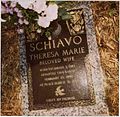 Terri Schiavo's grave

Ad. Transform your life with W8MD's
GLP-1 weight loss injections special from $29.99


W8MD Medical Weight Loss, Sleep and Medspa offers physician-supervised medical weight loss programs: NYC medical weight loss Philadelphia medical weight loss
Affordable GLP-1 Weight Loss ShotsAffordable GLP-1 Weight Loss Shots
Budget GLP-1 injections NYC (insurance & self-pay options) Popular treatments:
- Semaglutide starting from $29.99/week
- Tirzepatide starting from $45.00/week
✔ Most insurances accepted for visits ✔ Prior authorization support when eligible
Start your physician weight loss NYC journey today:
📍 NYC: Brooklyn weight loss center 📍 Philadelphia: Philadelphia weight loss center
📞 Call: 718-946-5500 (NYC) | 215-676-2334 (Philadelphia)
Tags: Affordable GLP1 weight loss NYC, Wegovy NYC, Zepbound NYC, Philadelphia medical weight loss


|
WikiMD Medical Encyclopedia |
Medical Disclaimer: WikiMD is not a substitute for professional medical advice. The information on WikiMD is provided as an information resource only, may be incorrect, outdated or misleading, and is not to be used or relied on for any diagnostic or treatment purposes. Please consult your health care provider before making any healthcare decisions or for guidance about a specific medical condition. WikiMD expressly disclaims responsibility, and shall have no liability, for any damages, loss, injury, or liability whatsoever suffered as a result of your reliance on the information contained in this site. By visiting this site you agree to the foregoing terms and conditions, which may from time to time be changed or supplemented by WikiMD. If you do not agree to the foregoing terms and conditions, you should not enter or use this site. See full disclaimer.
Credits:Most images are courtesy of Wikimedia commons, and templates, categories Wikipedia, licensed under CC BY SA or similar.
Translate this page: - East Asian
中文,
日本,
한국어,
South Asian
हिन्दी,
தமிழ்,
తెలుగు,
Urdu,
ಕನ್ನಡ,
Southeast Asian
Indonesian,
Vietnamese,
Thai,
မြန်မာဘာသာ,
বাংলা
European
español,
Deutsch,
français,
Greek,
português do Brasil,
polski,
română,
русский,
Nederlands,
norsk,
svenska,
suomi,
Italian
Middle Eastern & African
عربى,
Turkish,
Persian,
Hebrew,
Afrikaans,
isiZulu,
Kiswahili,
Other
Bulgarian,
Hungarian,
Czech,
Swedish,
മലയാളം,
मराठी,
ਪੰਜਾਬੀ,
ગુજરાતી,
Portuguese,
Ukrainian


