Medical genetics
Medical genetics is a branch of medicine that involves the diagnosis and management of hereditary disorders. Medical genetics differs from human genetics in that human genetics is a field of scientific research that may or may not apply to medicine, while medical genetics refers to the application of genetics to medical care.
Overview[edit]
Medical genetics encompasses many different areas, including clinical practice of physicians, genetic counselors, and nutritionists, clinical diagnostic laboratory activities, and research into the causes and inheritance of genetic disorders. Examples of conditions that fall within the scope of medical genetics include birth defects and dysmorphology, intellectual disability, autism, and rare syndromes.
History[edit]
The history of medical genetics is marked by the discovery of the genetic basis of a growing number of diseases. The first major breakthrough in medical genetics came in 1956, when it was discovered that Down syndrome was caused by an extra chromosome. Since then, medical genetics has made significant progress in understanding the genetic basis of diseases and in developing effective treatments.
Clinical genetics[edit]
Clinical genetics is the practice of clinical medicine with particular attention to hereditary disorders. This includes the diagnosis and management of genetic diseases, and the provision of genetic counseling and testing.
Genetic counseling[edit]
Genetic counseling is the process of helping people understand and adapt to the medical, psychological and familial implications of genetic contributions to disease. This process integrates the following:
- Interpretation of family and medical histories to assess the chance of disease occurrence or recurrence.
- Education about inheritance, testing, management, prevention, resources and research.
- Counseling to promote informed choices and adaptation to the risk or condition.
Genetic testing[edit]
Genetic testing is a type of medical test that identifies changes in chromosomes, genes, or proteins. The results of a genetic test can confirm or rule out a suspected genetic condition or help determine a person's chance of developing or passing on a genetic disorder.
See also[edit]
References[edit]
External links[edit]

This WikiMD article can only be edited by registered and verified editors. You can log in or register.
-
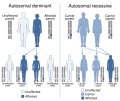 Autosomal dominant and recessive inheritance
 -
Human karyotype with bands and sub-bands
-
Scientist Pedigree


Medical Disclaimer: WikiMD is for informational purposes only and is not a substitute for professional medical advice. Content may be inaccurate or outdated and should not be used for diagnosis or treatment. Always consult your healthcare provider for medical decisions. Verify information with trusted sources such as CDC.gov and NIH.gov. By using this site, you agree that WikiMD is not liable for any outcomes related to its content. See full disclaimer.
Credits:Most images are courtesy of Wikimedia commons, and templates, categories Wikipedia, licensed under CC BY SA or similar.
Translate page: - East Asian
中文,
日本,
한국어,
South Asian
हिन्दी,
தமிழ்,
తెలుగు,
Urdu,
ಕನ್ನಡ,
Southeast Asian
Indonesian,
Vietnamese,
Thai,
မြန်မာဘာသာ,
বাংলা
European
español,
Deutsch,
français,
Greek,
português do Brasil,
polski,
română,
русский,
Nederlands,
norsk,
svenska,
suomi,
Italian
Middle Eastern & African
عربى,
Turkish,
Persian,
Hebrew,
Afrikaans,
isiZulu,
Kiswahili,
Other
Bulgarian,
Hungarian,
Czech,
Swedish,
മലയാളം,
मराठी,
ਪੰਜਾਬੀ,
ગુજરાતી,
Portuguese,
Ukrainian


