Retinoblastoma


Retinoblastoma (often abbreviated as Rb) is an uncommon eye cancer that arises from the retina, the light-sensitive inner lining of the eye. Predominantly affecting young children, it represents the leading primary malignant intraocular malignancy diagnosed in this age group.<ref name="ref1">[1]</ref> Although the prognosis for survival is generally favorable, the disease can result in vision loss or necessitate enucleation (removal of the eye).
Etiology and Genetics
Retinoblastoma's emergence can be ascribed to mutations in the chromosome 13's RB1 gene or MYCN gene aberrations.<ref name="ref2">[2]</ref> Approximately 45% of retinoblastoma cases stem from inherited genetic mutations. The RB1 gene functions as a tumor suppressor, and its dysfunction leads to unchecked cellular growth, resulting in tumorigenesis.
RB1 Gene: The hallmark of the inheritable form of retinoblastoma is the mutation in the RB1 gene situated on chromosome 13. Discovered as the inaugural tumor suppressor gene, RB1's main oncogenic restriction is achieved through the binding and inactivation of the E2F transcription factor, thereby preventing the transcription of S-phase crucial genes.<ref name="ref5">[5]</ref> Such genetic anomalies can either be passed down from parents or manifest spontaneously during early fetal development. This hereditary form predominantly results in bilateral retinoblastomas and is occasionally linked with tumors in the pineal gland or other central nervous system regions, a condition termed trilateral retinoblastoma.
MYCN Gene: A subset of non-familial, early-onset, unilateral retinoblastomas can be attributed to the MYCN oncogene's somatic amplification.<ref name="ref12">[12]</ref>
Clinical Presentation
The classical clinical sign of retinoblastoma is leukocoria (often termed "cat's eye reflex" or "amaurotic cat's eye reflex"), where the retina displays an anomalous white appearance when viewed through the pupil.<ref name="ref1">[1]</ref> Other manifestations encompass visual impairment, a reddened and irritated eye, growth delays, developmental lags, and strabismus (referred to as "cross-eyed" or "wall-eyed"). In resource-limited settings, late presentations with an enlarged eye are commonplace.
Diagnostic Evaluation
The diagnosis of retinoblastoma requires a comprehensive eye examination, usually conducted under anesthesia. While a white eye reflection (leukocoria) can suggest retinoblastoma, its presence might be due to other conditions such as Coats' disease or merely improper light reflection.
Initial screening measures for infants encompass:
- Red Reflex Test: Evaluating the retina's standard reddish-orange reflection using an ophthalmoscope in dim lighting.
- Corneal Light Reflex (Hirschberg Test): Ensures the eyes are not misaligned by observing symmetrical light reflection in both corneas.
- Eye Examination: Inspecting for any structural abnormalities.
Recent advances include smartphone applications designed to identify leukocoria in photographs.<ref name="ref13">[13]</ref>
Classification
Retinoblastomas can be categorized into heritable and non-heritable types. The heritable variant often manifests bilaterally, whereas the non-heritable form predominantly affects one eye (unilateral). However, the absence of familial history does not exclude the heritable form.
-
 Drawing of a large retinoblastoma
 -
 Aspect of trilateral retinoblastoma on MRI
 -
 An ocular ultrasound of a large retinoblastoma tumor within the eye of a 3-year-old boy
 -
 Funduscopic finding of a retinoblastoma
 -
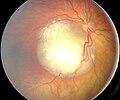 Ocular fundus aspect of retinoblastoma
 -
 Gross pathology of retinoblastoma tumor in enucleated eye of 3-year-old female
 -
 Large exophytic white tumor with foci of calcification producing total exudative retinal detachment
 -
 Flexner-Wintersteiner rosettes in retinoblastoma
 -
 Retinoblastoma, 400 X magnification
 -
 Crystal structure of the retinoblastoma tumor suppressor protein bound to E2F peptide polymer


Differential Diagnosis

Retinoblastoma's clinical manifestations can mimic other ocular conditions, necessitating its differentiation from:
- Persistent Hyperplastic Primary Vitreous
- Coats Disease
- Toxocariasis
- Retinopathy of Prematurity
Treatment and Prognosis
The treatment strategy for retinoblastoma hinges on the tumor's size, number, location, and potential metastasis. Options include chemotherapy, radiation therapy, laser therapy, and surgery. The overarching goal is the eradication of the tumor, preservation of vision, and prevention of metastasis.
See Also
Eye cancer Pediatric oncology Tumor suppressor
References
<references/>
 | |
|---|---|
 |
 |
| Small-blue-round-cell tumors |
|---|
|
|
| Tumours of the nervous system | ||||||||||||||||||||||||||||||||||||||
|---|---|---|---|---|---|---|---|---|---|---|---|---|---|---|---|---|---|---|---|---|---|---|---|---|---|---|---|---|---|---|---|---|---|---|---|---|---|---|
Note: Not all brain tumors are of nervous tissue, and not all nervous tissue tumors are in the brain (see brain metastasis).
|
| Eye neoplasm | ||||
|---|---|---|---|---|
|
Ad. Transform your life with W8MD's
GLP-1 weight loss injections special from $29.99 with insurance
|
WikiMD Medical Encyclopedia |
Medical Disclaimer: WikiMD is for informational purposes only and is not a substitute for professional medical advice. Content may be inaccurate or outdated and should not be used for diagnosis or treatment. Always consult your healthcare provider for medical decisions. Verify information with trusted sources such as CDC.gov and NIH.gov. By using this site, you agree that WikiMD is not liable for any outcomes related to its content. See full disclaimer.
Credits:Most images are courtesy of Wikimedia commons, and templates, categories Wikipedia, licensed under CC BY SA or similar.
Translate this page: - East Asian
中文,
日本,
한국어,
South Asian
हिन्दी,
தமிழ்,
తెలుగు,
Urdu,
ಕನ್ನಡ,
Southeast Asian
Indonesian,
Vietnamese,
Thai,
မြန်မာဘာသာ,
বাংলা
European
español,
Deutsch,
français,
Greek,
português do Brasil,
polski,
română,
русский,
Nederlands,
norsk,
svenska,
suomi,
Italian
Middle Eastern & African
عربى,
Turkish,
Persian,
Hebrew,
Afrikaans,
isiZulu,
Kiswahili,
Other
Bulgarian,
Hungarian,
Czech,
Swedish,
മലയാളം,
मराठी,
ਪੰਜਾਬੀ,
ગુજરાતી,
Portuguese,
Ukrainian
