Small-blue-round-cell tumor
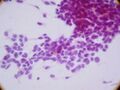
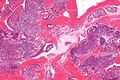
Small blue round cell tumor (SBRCT) is a term used to describe a group of neoplasms characterized by small, round, relatively undifferentiated cells. They are observed in microscopic examination and are most commonly found in the pediatric population. The group includes Ewing's sarcoma, neuroblastoma, rhabdomyosarcoma, Wilms' tumor, desmoplastic small round cell tumor, and synovial sarcoma.
Classification[edit]
SBRCTs are classified into the following types:
- Ewing's sarcoma: A rare disease in which cancer cells are found in the bone or in soft tissue.
- Neuroblastoma: A type of cancer that forms in certain types of nerve tissue.
- Rhabdomyosarcoma: A type of cancer that forms in skeletal muscle cells.
- Wilms' tumor: A type of cancer that starts in the kidneys.
- Desmoplastic small round cell tumor: A rare, aggressive form of cancer that primarily affects males.
- Synovial sarcoma: A type of cancer that occurs primarily in the extremities of the arms or legs.
Diagnosis[edit]
The diagnosis of SBRCTs is challenging due to their similar histological features. It often requires the use of immunohistochemistry and other advanced techniques such as fluorescence in situ hybridization (FISH) and reverse transcription polymerase chain reaction (RT-PCR).
Treatment[edit]
Treatment of SBRCTs typically involves a combination of surgery, radiation therapy, and chemotherapy. The choice of treatment depends on the type of SBRCT, its location, and the patient's overall health.
Prognosis[edit]
The prognosis of SBRCTs varies widely depending on the type of tumor, its location, and the patient's overall health. Some types of SBRCTs, such as Wilms' tumor and neuroblastoma, have relatively good prognoses with appropriate treatment, while others, such as desmoplastic small round cell tumor, have a poorer prognosis.
See also[edit]

This WikiMD article can only be edited by registered and verified editors. You can log in or register.
-
Small-blue-round-cell_tumor
-
 Small-blue-round-cell_tumor
 -
 Small-blue-round-cell_tumor


Medical Disclaimer: WikiMD is for informational purposes only and is not a substitute for professional medical advice. Content may be inaccurate or outdated and should not be used for diagnosis or treatment. Always consult your healthcare provider for medical decisions. Verify information with trusted sources such as CDC.gov and NIH.gov. By using this site, you agree that WikiMD is not liable for any outcomes related to its content. See full disclaimer.
Credits:Most images are courtesy of Wikimedia commons, and templates, categories Wikipedia, licensed under CC BY SA or similar.
Translate page: - East Asian
中文,
日本,
한국어,
South Asian
हिन्दी,
தமிழ்,
తెలుగు,
Urdu,
ಕನ್ನಡ,
Southeast Asian
Indonesian,
Vietnamese,
Thai,
မြန်မာဘာသာ,
বাংলা
European
español,
Deutsch,
français,
Greek,
português do Brasil,
polski,
română,
русский,
Nederlands,
norsk,
svenska,
suomi,
Italian
Middle Eastern & African
عربى,
Turkish,
Persian,
Hebrew,
Afrikaans,
isiZulu,
Kiswahili,
Other
Bulgarian,
Hungarian,
Czech,
Swedish,
മലയാളം,
मराठी,
ਪੰਜਾਬੀ,
ગુજરાતી,
Portuguese,
Ukrainian


