Asparagine synthetase: Difference between revisions
No edit summary |
CSV import |
||
| Line 32: | Line 32: | ||
[[Category:Amino acid metabolism]] | [[Category:Amino acid metabolism]] | ||
[[Category:EC 6.3.5]] | [[Category:EC 6.3.5]] | ||
<gallery> | |||
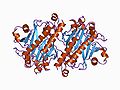
File:PDB_11as_EBI.jpg|PDB 11as EBI | |||
</gallery> | |||
Latest revision as of 00:34, 27 February 2025
Asparagine synthetase is an enzyme that plays a crucial role in the biosynthesis of the amino acid asparagine. It catalyzes the ATP-dependent conversion of aspartate and glutamine into asparagine and glutamate. This reaction is essential for the production of asparagine, which is a non-essential amino acid in humans but is vital for protein synthesis and cellular function.
Structure and Function[edit]
Asparagine synthetase is a member of the ligase family of enzymes, specifically classified under the EC number 6.3.5.4. The enzyme is a homodimer, meaning it consists of two identical subunits. Each subunit contains an active site where the conversion of substrates occurs.
The enzyme operates through a two-step reaction mechanism:
1. Activation of Aspartate: The enzyme first activates aspartate by forming a β-aspartyl-AMP intermediate, using ATP as a cofactor. 2. Amidation: The activated aspartate is then amidated by the amide nitrogen from glutamine, resulting in the formation of asparagine and glutamate.
Biological Significance[edit]
Asparagine synthetase is expressed in various tissues, with particularly high levels in the pancreas and brain. The enzyme's activity is crucial for maintaining the balance of amino acids in the body and supporting the synthesis of proteins.
In cancer biology, asparagine synthetase has gained attention because some cancer cells rely heavily on asparagine for growth and survival. Inhibiting this enzyme can starve cancer cells of asparagine, leading to cell death. This has led to the development of therapeutic strategies targeting asparagine metabolism in cancer treatment.
Clinical Implications[edit]
Deficiencies in asparagine synthetase can lead to a rare genetic disorder known as Asparagine Synthetase Deficiency (ASD), characterized by severe developmental delay, microcephaly, and intractable seizures. Genetic mutations affecting the enzyme's function are responsible for this condition.
Research and Therapeutic Applications[edit]
Research into asparagine synthetase has expanded into exploring its role in metabolic disorders and cancer therapy. Inhibitors of asparagine synthetase are being investigated as potential treatments for certain types of cancer, particularly those that are dependent on asparagine for growth.
Also see[edit]
| Enzymes | ||||||||||
|---|---|---|---|---|---|---|---|---|---|---|
|
| Encoded (proteinogenic) amino acids | ||||||||||||||||
|---|---|---|---|---|---|---|---|---|---|---|---|---|---|---|---|---|
|
-
 PDB 11as EBI

