Familial exudative vitreoretinopathy: Difference between revisions
From WikiMD's Medical Encyclopedia
CSV import |
CSV import |
||
| Line 105: | Line 105: | ||
[[Category:Disorders of choroid and retina]] | [[Category:Disorders of choroid and retina]] | ||
{{dictionary-stub1}} | {{dictionary-stub1}} | ||
<gallery> | |||
File:Human_eye_cross_section_detached_retina.svg|Cross section of human eye with detached retina | |||
File:Human_eye_cross-sectional_view_grayscale.png|Grayscale cross-sectional view of human eye | |||
File:Photocoagulation.png|Photocoagulation procedure illustration | |||
</gallery> | |||
Revision as of 04:10, 18 February 2025
| Familial exudative vitreoretinopathy | |
|---|---|

| |
| Synonyms | FEVR (initialism), Criswick-Schepens syndrome |
| Pronounce | (initialism) |
| Field | |
| Symptoms | |
| Complications | |
| Onset | |
| Duration | |
| Types | |
| Causes | |
| Risks | |
| Diagnosis | |
| Differential diagnosis | |
| Prevention | |
| Treatment | |
| Medication | |
| Prognosis | |
| Frequency | |
| Deaths | |
Familial exudative vitreoretinopathy (FEVR, pronounced as fever) is a genetic disorder affecting the growth and development of blood vessels in the retina of the eye.<ref name="pmid20738858">Shastry BS,
 Genetic susceptibility to advanced retinopathy of prematurity (ROP),
 J. Biomed. Sci.,
 2010,
 Vol. 17,
 pp. 69,
 DOI: 10.1186/1423-0127-17-69,
 PMID: 20738858,
 PMC: 2933676,</ref>  This disease can lead to visual impairment and sometimes complete blindness in one or both eyes.  FEVR is characterized by exudative leakage and hemorrhage of the blood vessels in the retina, along with incomplete vascularization of the peripheral retina.  The disease process can lead to retinal folds, tears, and detachments.
Causes
Genetic types include:
| Type | OMIM | Gene | Locus |
|---|---|---|---|
| EVR1 | Template:OMIM2 | FZD4 | 11q14-q21 |
| EVR2 | Template:OMIM2 | NDP | Xp11.4 |
| EVR3 | Template:OMIM2 | ? (exact gene unknown) | 11p13-p12 |
| EVR4 | Template:OMIM2 | LRP5 | 11q13.4 |
| EVR5 | Template:OMIM2 | TSPAN12 | 7q31 |
| EVR6 | Template:OMIM2 | ZNF408 | 11p11.2 |
| EVR7 | Template:OMIM2 | CTNNB1 | 3p22.1 |
References
External links
- GeneReviews/NCBI/NIH/UW entry on Familial Exudative Vitreoretinopathy, Autosomal Dominant
- NCBI Genetic Testing Registry
| Congenital malformations and deformations of eyes | ||||
|---|---|---|---|---|
|
| Cell membrane protein disorders (other than Cell surface receptor, enzymes, and cytoskeleton) | ||||||||||
|---|---|---|---|---|---|---|---|---|---|---|
See also other cell membrane proteins
|

-
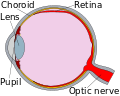 Cross section of human eye with detached retina
 -
Grayscale cross-sectional view of human eye
-
 Photocoagulation procedure illustration


