Cardiovascular examination: Difference between revisions
CSV import Tags: mobile edit mobile web edit |
CSV import |
||
| Line 33: | Line 33: | ||
{{Medicine}} | {{Medicine}} | ||
{{Cardiology-stub}} | {{Cardiology-stub}} | ||
<gallery> | |||
File:Location_of_Heart_Sounds_for_Auscultation.png|Location of Heart Sounds for Auscultation | |||
</gallery> | |||
Latest revision as of 00:59, 17 February 2025
Cardiovascular Examination is a critical component of the physical examination conducted by healthcare professionals to assess the cardiovascular system. It involves a systematic evaluation of the heart and blood vessels, and it is essential in diagnosing various cardiovascular diseases.
Overview[edit]
The cardiovascular examination is a comprehensive assessment that includes the evaluation of the patient's medical history, a physical examination, and often, further diagnostic tests. The examination is typically performed in a systematic manner, starting with inspection, followed by palpation, percussion, and auscultation.
Inspection[edit]
Inspection involves observing the patient for any visible signs of cardiovascular disease. This may include noting the patient's color, breathing pattern, and any visible pulsations. The healthcare professional may also look for signs of peripheral vascular disease such as varicose veins or ulcers.
Palpation[edit]
Palpation involves the use of the hands to feel the chest wall for any abnormal vibrations or movements. The healthcare professional may also palpate the peripheral pulses to assess their strength and rhythm.
Percussion[edit]
Percussion is less commonly used in the cardiovascular examination but can be helpful in assessing the size and borders of the heart.
Auscultation[edit]
Auscultation involves listening to the heart sounds with a stethoscope. The healthcare professional listens for the normal heart sounds, as well as any additional sounds such as murmurs or rubs that may indicate disease.
Diagnostic Tests[edit]
Further diagnostic tests may be performed based on the findings of the cardiovascular examination. These may include electrocardiogram (ECG), echocardiogram, and cardiac stress test.
Conclusion[edit]
The cardiovascular examination is a vital tool in the diagnosis and management of cardiovascular diseases. It requires a thorough understanding of the cardiovascular system and the ability to interpret the findings accurately.

This article is a cardiovascular system stub. You can help WikiMD by expanding it!
-
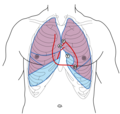 Location of Heart Sounds for Auscultation

