Atransferrinemia: Difference between revisions
No edit summary |
CSV import |
||
| Line 91: | Line 91: | ||
[[Category:Red blood cell disorders]] | [[Category:Red blood cell disorders]] | ||
[[Category:Metabolic disorders]] | [[Category:Metabolic disorders]] | ||
== Atransferrinemia == | |||
<gallery> | |||
File:autorecessive.svg|Autosomal Recessive Inheritance | |||
File:Protein TF PDB 1a8e.png|Transferrin Protein Structure | |||
File:Iron deficiency anemia blood film.jpg|Iron Deficiency Anemia Blood Film | |||
File:Erythrozytenkonzentrat neu.jpg|Erythrocyte Concentrate | |||
</gallery> | |||
Revision as of 00:48, 20 February 2025
| Atransferrinemia | |
|---|---|

| |
| Synonyms | Familial atransferrinemia |
| Pronounce | N/A |
| Field | Hematology |
| Symptoms | Anemia, iron overload |
| Complications | Heart failure, liver damage, arthritis |
| Onset | N/A |
| Duration | N/A |
| Types | N/A |
| Causes | Mutations in the transferrin (TF) gene |
| Risks | N/A |
| Diagnosis | Transferrin levels, blood tests, genetic testing, physical examination |
| Differential diagnosis | N/A |
| Prevention | N/A |
| Treatment | Apotransferrin therapy |
| Medication | None; iron therapy is contraindicated |
| Prognosis | Manageable with appropriate treatment |
| Frequency | Extremely rare (fewer than 15 cases documented) |
| Deaths | Rare; often due to complications if untreated |
Atransferrinemia is a rare genetic disorder that falls under inborn errors of metal metabolism. It is caused by a deficiency or absence of transferrin, a plasma protein responsible for transporting iron in the bloodstream. A lack of transferrin disrupts iron delivery to cells, leading to anemia and hemosiderosis (iron overload) in organs such as the heart, liver, and pancreas.
Clinical Features
The primary symptoms of atransferrinemia include:
- Severe microcytic anemia (small, pale red blood cells)
- Iron deposition in organs, leading to:
- Recurrent infections due to weakened immune response.
The anemia is both microcytic and hypochromic, with red blood cells unable to function properly due to insufficient iron delivery.
Pathophysiology
The transferrin protein, encoded by the TF gene, is crucial for transporting iron to the reticuloendothelial system for erythropoiesis. In atransferrinemia, the absence of transferrin leads to:
- An inability to deliver iron for red blood cell production.
- Excess iron accumulating in the heart, liver, pancreas, and joints, causing tissue damage.
- Elevated serum ferritin levels as the body attempts to bind excess free iron.
Genetics
Atransferrinemia is inherited in an autosomal recessive manner, meaning a person must inherit defective copies of the TF gene from both parents. Mutations in the TF gene impair the production or function of transferrin. Genetic testing can confirm mutations in affected individuals.
Diagnosis
Diagnosing atransferrinemia involves:
- Blood tests showing severe anemia with microcytic and hypochromic characteristics.
- Measurement of transferrin levels, which are typically absent or very low.
- Genetic testing to identify mutations in the TF gene.
- Imaging studies to assess iron overload in organs.
Differential diagnosis includes other conditions that cause microcytic anemia, such as iron-deficiency anemia and thalassemia.
Treatment
The cornerstone of treatment is:
- Apotransferrin therapy: This replaces the missing transferrin protein and restores proper iron transport.
- Management of iron overload:
- Iron chelation therapy may be required to prevent organ damage.
- Avoidance of iron therapy: Oral or intravenous iron supplements are contraindicated, as they exacerbate iron overload without correcting anemia.
Prognosis
With early diagnosis and appropriate treatment, the prognosis for atransferrinemia is favorable. Left untreated, complications such as cardiac failure and liver cirrhosis can be life-threatening.
Epidemiology
Atransferrinemia is an extremely rare condition, with fewer than 15 documented cases worldwide. Most cases are identified in consanguineous families due to the autosomal recessive inheritance pattern.
Related Conditions
See Also
References
Further Reading
- Ronald,
 Hematology: Diagnosis and Treatment. online version,

 Elsevier Health Sciences,
 2012,


 ISBN 9781455740413,
- Vincent,
 Differential Diagnosis by Laboratory Medicine: A Quick Reference for Physicians,

 Springer,
 2002,


 ISBN 9783540430575,
External Links
| Inborn error of metal metabolism (E83, 275) | ||||
|---|---|---|---|---|
|
Atransferrinemia
-
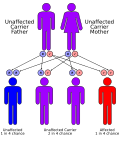 Autosomal Recessive Inheritance
 -
 Transferrin Protein Structure
 -
 Iron Deficiency Anemia Blood Film
 -
 Erythrocyte Concentrate


