Cerebrospinal fluid leak: Difference between revisions
CSV import |
CSV import |
||
| Line 91: | Line 91: | ||
[[Category:Central nervous system disorders]] | [[Category:Central nervous system disorders]] | ||
{{dictionary-stub1}} | {{dictionary-stub1}} | ||
== Cerebrospinal_fluid_leak == | |||
<gallery> | |||
File:CSF_circulation.png|Diagram of cerebrospinal fluid circulation | |||
File:1316_Meningeal_LayersN.jpg|Meningeal layers of the brain | |||
File:MRI_of_human_brain_with_type-1_Arnold-Chiari_malformation_and_herniated_cerebellum.jpg|MRI showing type-1 Arnold-Chiari malformation | |||
File:Spinal_needles.jpg|Various types of spinal needles | |||
File:Epidural_blood_patch.svg|Diagram of an epidural blood patch procedure | |||
</gallery> | |||
Revision as of 04:25, 18 February 2025
Injury
| Cerebrospinal fluid leak | |
|---|---|
| [[File:|250px|alt=|]] | |
| Synonyms | CSF leak |
| Pronounce | |
| Field | |
| Symptoms | |
| Complications | |
| Onset | |
| Duration | |
| Types | |
| Causes | |
| Risks | |
| Diagnosis | |
| Differential diagnosis | |
| Prevention | |
| Treatment | |
| Medication | |
| Prognosis | |
| Frequency | |
| Deaths | |
A cerebrospinal fluid leak (CSF leak) is a medical condition where the cerebrospinal fluid (CSF) in the brain or spinal cord leaks out of one or more holes or tears in the arachnoid and dura mater.<ref>MedlinePlus Encyclopedia: CSF leak
</ref><ref>Cerebrospinal Fluid Leak Imaging at eMedicine
</ref> A spinal CSF leak can also be caused by meningeal diverticula or CSF-venous fistula not associated with an epidural leak.<ref name=":0">Kranz, Peter G.,
 Myelographic Techniques for the Detection of Spinal CSF Leaks in Spontaneous Intracranial Hypotension,
 American Journal of Roentgenology,

 Vol. 206(Issue: 1),
 pp. 8–19,
 DOI: 10.2214/AJR.15.14884,
 PMID: 26700332,</ref> <ref name=":1">Kranz, Peter G.,
 CSF Venous Fistulas in Spontaneous Intracranial Hypotension: Imaging Characteristics on Dynamic and CT Myelography,
 AJR. American Journal of Roentgenology,

 Vol. 209(Issue: 6),
 pp. 1360–1366,
 DOI: 10.2214/AJR.17.18351,
 PMID: 29023155,</ref><ref name=":2" />
CSF leaks are often further classified according to the cause. An iatrogenic or traumatic CSF leak has an identified cause such as a lumbar puncture (noted by a post-dural-puncture headache), surgery or physical trauma; while a spontaneous cerebrospinal fluid leak has an unknown cause. CSF leaks are associated with heritable connective tissue disorders including Marfan syndrome and Ehlers-Danlos syndrome.<ref>,
 Connective tissue spectrum abnormalities associated with spontaneous cerebrospinal fluid leaks: a prospective study.,
 European Journal of Human Genetics,

 Vol. 21(Issue: 4),
 pp. 386–390,
 DOI: 10.1038/ejhg.2012.191,
 PMID: 22929030,
 PMC: 3598315,</ref>
Signs and symptoms
The most common symptom of a CSF leak is a fast-onset, extremely painful orthostatic headache or thunderclap headache.<ref> ,
 Thunderclap headaches - Symptoms and causes Full text,
 Mayo Clinic,


 Accessed on: 2018-08-01.
</ref>
Patients with a spinal leak may suffer intracranial hypotension (low CSF pressure) because the body cannot replenish the CSF fast enough to keep pace with the leak. As a result, the brain may sag inside the skull and into the foramen magnum, which is visible (and measurable) with an MRI of the brain. Patients with a cranial leak are more likely to suffer intracranial hypertension (high CSF pressure), and are at risk of meningitis. Some patients with either a cranial or spinal leak can fluctuate between high and low CSF pressure.
While high CSF pressure can make lying down unbearable, low CSF pressure due to a leak can be relieved by lying flat on the back.<ref name=":3">
CSF Leak: A Curable Cause of Headache(link). www.cedars-sinai.edu.
Accessed 2018-08-01.
</ref>
Other symptoms of a CSF leak can include neck pain, photophobia, dizziness, gait disturbances, tinnitus, visual disturbances, brain fog, nausea, fluid dripping from the nose or ears, and a metallic taste in the mouth. An untreated CSF leak can result in coma or death.<ref>
Headache Secondary to Intracranial Hypotension, Schievink, W and Deline, C(link). www.researchgate.net.
Accessed 2018-09-22.
</ref>
Movement disorders are uncommon in spontaneous CSF leaks but occasionally can be one of the major components of the clinical presentation.<ref>Mokri, Bahram,
 Movement disorders associated with spontaneous CSF leaks: a case series,
 Cephalalgia: An International Journal of Headache,

 Vol. 34(Issue: 14),
 pp. 1134–1141,
 DOI: 10.1177/0333102414531154,
 PMID: 24728303,</ref>
Diagnosis
CSF leaks are frequently misdiagnosed by physicians as migraine, Chiari malformation, dysautonomia or conversion disorder.
Routine imaging assessment should begin with contrast-enhanced brain MRI with sagittal reformats. <ref name=":0" /><ref name=":2">Kranz, Peter G.,
 Spontaneous Intracranial Hypotension: Pathogenesis, Diagnosis, and Treatment,
 Neuroimaging Clinics of North America,

 Vol. 29(Issue: 4),
 pp. 581–594,
 DOI: 10.1016/j.nic.2019.07.006,
 PMID: 31677732,</ref> Brain MRI should be assessed for signs of SEEPS <ref name=":3" />:
- Subdural fluid collections
- Enhancement of the meninges
- Engorgement of venous structures
- Pituitary swelling
- Sagging of the brain
For suspected spinal CSF leaks, spine imaging should be used to guide treatment. <ref name=":2" />
Other imaging can be helpful in diagnosing a CSF leak, and in identifying its location, typically using a CT scan or an MRI scan. A myelogram can be used to more precisely identify the location of a CSF leak by injecting a dye to further enhance the imaging. However, CSF leaks are frequently not visible on imaging.
For patients with recalcitrant spontaneous intracranial hypotension and no leak found on conventional spinal imaging, digital subtraction myelography, CT myelography and dynamic myelography (a modified conventional myelography technique) should be considered to rule out a CSF-venous fistula.<ref>Schievink, Wouter I.,
 Digital subtraction myelography for the identification of spontaneous spinal CSF-venous fistulas,
 Journal of Neurosurgery. Spine,

 Vol. 24(Issue: 6),
 pp. 960–964,
 DOI: 10.3171/2015.10.SPINE15855,
 PMID: 26849709,</ref> <ref name=":1" /> In addition, presence of a hyperdense paraspinal vein should be investigated in imaging as it is highly suggestive of a CSF venous fistula.<ref>Clark, Michael S.,
 Prevalence of hyperdense paraspinal vein sign in patients with spontaneous intracranial hypotension without dural CSF leak on standard CT myelography,
 Diagnostic and Interventional Radiology (Ankara, Turkey),

 Vol. 24(Issue: 1),
 pp. 54–59,
 DOI: 10.5152/dir.2017.17220,
 PMID: 29217497,
 PMC: 5765931,</ref>
Fluid dripping from the nose (CSF rhinorrhoea) or ears (CSF otorrhea) should be collected and tested for the protein Beta-2 transferrin which would be highly accurate in identifying CS fluid and diagnosing a cranial CSF leak.<ref>O'Cearbhaill, Roisin M.,
 Beta-2 Transferrin and IR,
 Journal of Vascular and Interventional Radiology: JVIR,

 Vol. 29(Issue: 3),
 pp. 439,
 DOI: 10.1016/j.jvir.2017.10.002,
 PMID: 29455884,</ref>
Treatment
Symptomatic treatment usually involves analgesics for both cranial and spinal CSF leaks. Caffeine and short-term bed rest can alleviate symptoms of low CSF pressure, while elevated rest and acetazolamide can alleviate symptoms of high CSF pressure.
Sometimes a CSF leak will heal spontaneously. Otherwise, symptoms may last months or even years. An epidural blood patch is the typical treatment for a CSF leak, where up to 20 cubic centimeters of the patient's blood is drawn, then injected into either the lumbar or cervical spine, close to the known or suspected site of the leak. Fibrin glue patching is an alternative where blood patching is unsuccessful. If the site of the leak is known, neurosurgical repair of the dura mater is an option.
Surgery to treat a CSF-venous fistula in CSF leak patients is highly effective. <ref>Wang, Timothy Y.,
 Clinical Outcomes Following Surgical Ligation of Cerebrospinal Fluid-Venous Fistula in Patients With Spontaneous Intracranial Hypotension: A Prospective Case Series,
 Operative Neurosurgery (Hagerstown, Md.),

 Vol. 18(Issue: 3),
 pp. 239–245,
 DOI: 10.1093/ons/opz134,
 PMID: 31134267,</ref>
The use of antibiotics to prevent meningitis in those with a CSF leak due to a skull fracture is of unclear benefit.<ref>,
 Antibiotic prophylaxis for preventing meningitis in patients with basilar skull fractures.,
 The Cochrane Database of Systematic Reviews,


 pp. CD004884,
 DOI: 10.1002/14651858.CD004884.pub4,
 PMID: 25918919,</ref>
References
<references group="" responsive="1"></references>
External links

Cerebrospinal_fluid_leak
-
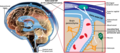 Diagram of cerebrospinal fluid circulation
 -
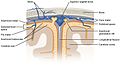 Meningeal layers of the brain
 -
 MRI showing type-1 Arnold-Chiari malformation
 -
 Various types of spinal needles
 -
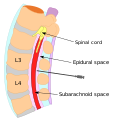 Diagram of an epidural blood patch procedure


