Chest pain in children

Editor-In-Chief: Prab R Tumpati, MD
Obesity, Sleep & Internal medicine
Founder, WikiMD Wellnesspedia &
W8MD's weight loss doctor NYC
Philadelphia GLP-1 weight loss and GLP-1 clinic NYC
| Chest pain in children | |
|---|---|

| |
| Synonyms | N/A |
| Pronounce | N/A |
| Specialty | N/A |
| Symptoms | Chest pain, shortness of breath, palpitations, dizziness |
| Complications | Anxiety, reduced physical activity |
| Onset | Typically in school-aged children |
| Duration | Varies, often transient |
| Types | N/A |
| Causes | Musculoskeletal pain, asthma, gastroesophageal reflux disease, psychogenic pain |
| Risks | Family history, stress, physical activity |
| Diagnosis | Clinical evaluation, history taking, physical examination, chest X-ray, electrocardiogram |
| Differential diagnosis | Costochondritis, pneumonia, pericarditis, myocarditis |
| Prevention | Stress management, proper warm-up exercises |
| Treatment | Reassurance, analgesics, treatment of underlying cause |
| Medication | N/A |
| Prognosis | Generally good |
| Frequency | Common in children |
| Deaths | N/A |
Chest pain in children is a common symptom that can be caused by many different factors. While it is often less serious than chest pain in adults, it can still be a cause for concern and should be evaluated by a healthcare professional.
Causes[edit]
Chest pain in children can be caused by a variety of factors. These can be broadly categorized into cardiac and non-cardiac causes.
Cardiac Causes[edit]
Cardiac causes of chest pain in children are relatively rare, but can include conditions such as congenital heart disease, myocarditis, and pericarditis. These conditions can cause chest pain by affecting the heart's structure or function.
Non-Cardiac Causes[edit]
Non-cardiac causes of chest pain in children are more common and can include conditions such as asthma, pneumonia, gastroesophageal reflux disease (GERD), and musculoskeletal pain. These conditions can cause chest pain by affecting the lungs, digestive system, or muscles and bones of the chest.
Symptoms[edit]
In addition to chest pain, children may also experience other symptoms such as shortness of breath, cough, fever, or abdominal pain. The presence of these symptoms can help healthcare professionals determine the underlying cause of the chest pain.
Diagnosis[edit]
The diagnosis of chest pain in children typically involves a thorough medical history and physical examination. Additional tests such as an electrocardiogram (ECG), chest X-ray, or blood tests may also be performed to help identify the cause of the chest pain.
Treatment[edit]
The treatment of chest pain in children depends on the underlying cause. Treatment may involve medications, lifestyle changes, or in some cases, surgery.
Gallery[edit]
-
 Brugada syndrome type 1 example
 -
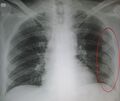 Fractured ribs marked
 -
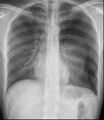 Spontaneous pneumothorax
 -
 Cause of chest pain in children and adolescents
.png)


See Also[edit]
 | This medical article is a stub. You can help WikiMD by expanding the page. |

Medical Disclaimer: WikiMD is for informational purposes only and is not a substitute for professional medical advice. Content may be inaccurate or outdated and should not be used for diagnosis or treatment. Always consult your healthcare provider for medical decisions. Verify information with trusted sources such as CDC.gov and NIH.gov. By using this site, you agree that WikiMD is not liable for any outcomes related to its content. See full disclaimer.
Credits:Most images are courtesy of Wikimedia commons, and templates, categories Wikipedia, licensed under CC BY SA or similar.
Translate page: - East Asian
中文,
日本,
한국어,
South Asian
हिन्दी,
தமிழ்,
తెలుగు,
Urdu,
ಕನ್ನಡ,
Southeast Asian
Indonesian,
Vietnamese,
Thai,
မြန်မာဘာသာ,
বাংলা
European
español,
Deutsch,
français,
Greek,
português do Brasil,
polski,
română,
русский,
Nederlands,
norsk,
svenska,
suomi,
Italian
Middle Eastern & African
عربى,
Turkish,
Persian,
Hebrew,
Afrikaans,
isiZulu,
Kiswahili,
Other
Bulgarian,
Hungarian,
Czech,
Swedish,
മലയാളം,
मराठी,
ਪੰਜਾਬੀ,
ગુજરાતી,
Portuguese,
Ukrainian

