Abdominal fascia
Layer of connective tissue in the abdomen
| Anatomy and morphology | ||||||||||
|---|---|---|---|---|---|---|---|---|---|---|
|
Abdominal fascia refers to the layers of connective tissue that cover and support the abdominal wall and abdominal organs. These layers play a crucial role in maintaining the structural integrity of the abdomen and facilitating movement and function of the abdominal muscles and organs.
Structure
The abdominal fascia is composed of several distinct layers, each with specific characteristics and functions. These layers include:
Superficial fascia
The superficial fascia is the outermost layer of the abdominal fascia. It is a loose connective tissue layer that contains varying amounts of adipose tissue. In the lower abdomen, it is divided into two layers: the Camper's fascia, which is the fatty superficial layer, and the Scarpa's fascia, which is a more membranous deep layer.
Deep fascia
Beneath the superficial fascia lies the deep fascia, which is a denser and more fibrous layer. This layer envelops the muscles of the abdominal wall, providing support and allowing for the transmission of forces across the abdomen. The deep fascia is continuous with the transversalis fascia, which lines the inner surface of the abdominal wall.
Transversalis fascia
The transversalis fascia is a thin aponeurotic membrane that lies between the inner surface of the abdominal muscles and the peritoneum. It plays a role in separating the abdominal cavity from the extraperitoneal space and provides a plane for surgical dissection.
Endoabdominal fascia
The endoabdominal fascia is a collective term for the fascia that lines the inner surface of the abdominal cavity. It includes the transversalis fascia and other fascial layers that cover the diaphragm, psoas major, and quadratus lumborum muscles.
Function
The abdominal fascia serves several important functions:
- Support: It provides structural support to the abdominal wall and helps maintain the position of the abdominal organs.
- Protection: The fascia acts as a protective barrier, shielding the internal organs from external forces and trauma.
- Movement: It facilitates the movement and contraction of the abdominal muscles, which are essential for activities such as breathing, coughing, and defecation.
- Compartmentalization: The fascia helps compartmentalize the abdominal cavity, aiding in the organization and separation of different anatomical structures.
Clinical significance
The abdominal fascia is of clinical importance in various surgical procedures and medical conditions. For example, during abdominal surgeries, surgeons must carefully navigate through the fascial layers to access the abdominal cavity. Additionally, conditions such as hernias involve the protrusion of abdominal contents through weakened areas of the fascia.
Related pages
Gallery
-
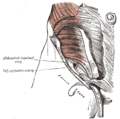 Diagram of the abdominal fascia

Ad. Transform your life with W8MD's Budget GLP-1 injections from $29.99


W8MD offers a medical weight loss program to GLP1 weight loss doctor Philadelphia. Our physician-supervised medical weight loss NYC provides:
- Weight loss injections NYC (generic and brand names):
- Zepbound / Mounjaro, Wegovy
- Learn more on Budget GLP1 weight loss injections NYC & Philadelphia GLP1 weight loss shots
- Most insurances accepted.
- Generic GLP1 weight loss injections from $29.99/week for Semaglutide and $45.00/week for Tirzepatide with insurance.
- Also offer prescription weight loss medications including Phentermine, Qsymia, Diethylpropion, Contrave etc.
NYC weight loss doctor appointmentsNYC weight loss doctor appointments
Start your NYC weight loss journey today at our NYC medical weight loss and Philadelphia medical weight loss clinics.
- Call 718-946-5500 to lose weight in NYC or for medical weight loss in Philadelphia 215-676-2334.
- Tags:GLP1 medical weight loss doctor NYC, Zepbound NYC, Budget GLP1 weight loss injections, Wegovy Philadelphia, Wegovy NYC, Brookly weight loss Wegovy NYC and Budget GLP1 shots NYC


|
WikiMD's Wellness Encyclopedia |
| Let Food Be Thy Medicine Medicine Thy Food - Hippocrates |
Medical Disclaimer: WikiMD is not a substitute for professional medical advice. The information on WikiMD is provided as an information resource only, may be incorrect, outdated or misleading, and is not to be used or relied on for any diagnostic or treatment purposes. Please consult your health care provider before making any healthcare decisions or for guidance about a specific medical condition. WikiMD expressly disclaims responsibility, and shall have no liability, for any damages, loss, injury, or liability whatsoever suffered as a result of your reliance on the information contained in this site. By visiting this site you agree to the foregoing terms and conditions, which may from time to time be changed or supplemented by WikiMD. If you do not agree to the foregoing terms and conditions, you should not enter or use this site. See full disclaimer.
Credits:Most images are courtesy of Wikimedia commons, and templates, categories Wikipedia, licensed under CC BY SA or similar.
Translate this page: - East Asian
中文,
日本,
한국어,
South Asian
हिन्दी,
தமிழ்,
తెలుగు,
Urdu,
ಕನ್ನಡ,
Southeast Asian
Indonesian,
Vietnamese,
Thai,
မြန်မာဘာသာ,
বাংলা
European
español,
Deutsch,
français,
Greek,
português do Brasil,
polski,
română,
русский,
Nederlands,
norsk,
svenska,
suomi,
Italian
Middle Eastern & African
عربى,
Turkish,
Persian,
Hebrew,
Afrikaans,
isiZulu,
Kiswahili,
Other
Bulgarian,
Hungarian,
Czech,
Swedish,
മലയാളം,
मराठी,
ਪੰਜਾਬੀ,
ગુજરાતી,
Portuguese,
Ukrainian
