Transversalis fascia
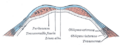
The transversalis fascia is a thin aponeurotic membrane that lies between the inner surface of the transversus abdominis muscle and the extraperitoneal fat. It is an important structure in the abdominal wall, providing support and separation between the muscular and peritoneal layers.

Structure[edit]
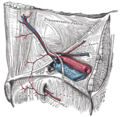
The transversalis fascia is continuous with the fascia covering the diaphragm and the iliac fascia. It is also connected to the inguinal ligament and extends into the pelvis, where it becomes the pelvic fascia. The fascia is thin and fibrous, providing a layer of support and protection for the abdominal cavity.

Function[edit]
The primary function of the transversalis fascia is to act as a supportive layer for the abdominal wall. It helps maintain the integrity of the abdominal cavity and provides a surface for the attachment of the peritoneum. Additionally, it plays a role in the formation of the inguinal canal, which is important for the passage of structures such as the spermatic cord in males and the round ligament of the uterus in females.
Clinical Significance[edit]
The transversalis fascia is involved in various surgical procedures, particularly those related to hernia repair. Understanding its anatomy is crucial for surgeons performing laparoscopic surgery and other interventions in the abdominal region. Weaknesses in the transversalis fascia can lead to the development of inguinal hernias.

Related Structures[edit]
The transversalis fascia is closely associated with several other structures in the abdominal wall, including:
Related Pages[edit]
References[edit]
- Standring, S. (2016). Gray's Anatomy: The Anatomical Basis of Clinical Practice. 41st Edition. Elsevier.
- Moore, K. L., Dalley, A. F., & Agur, A. M. R. (2013). Clinically Oriented Anatomy. 7th Edition. Lippincott Williams & Wilkins.

-
 Transversalis fascia
 -
 Transversalis fascia


Medical Disclaimer: WikiMD is for informational purposes only and is not a substitute for professional medical advice. Content may be inaccurate or outdated and should not be used for diagnosis or treatment. Always consult your healthcare provider for medical decisions. Verify information with trusted sources such as CDC.gov and NIH.gov. By using this site, you agree that WikiMD is not liable for any outcomes related to its content. See full disclaimer.
Credits:Most images are courtesy of Wikimedia commons, and templates, categories Wikipedia, licensed under CC BY SA or similar.
Translate page: - East Asian
中文,
日本,
한국어,
South Asian
हिन्दी,
தமிழ்,
తెలుగు,
Urdu,
ಕನ್ನಡ,
Southeast Asian
Indonesian,
Vietnamese,
Thai,
မြန်မာဘာသာ,
বাংলা
European
español,
Deutsch,
français,
Greek,
português do Brasil,
polski,
română,
русский,
Nederlands,
norsk,
svenska,
suomi,
Italian
Middle Eastern & African
عربى,
Turkish,
Persian,
Hebrew,
Afrikaans,
isiZulu,
Kiswahili,
Other
Bulgarian,
Hungarian,
Czech,
Swedish,
മലയാളം,
मराठी,
ਪੰਜਾਬੀ,
ગુજરાતી,
Portuguese,
Ukrainian

