Arcturus Therapeutics
Anatomical structure in the cardiovascular system
| Anatomy and morphology | ||||||||||
|---|---|---|---|---|---|---|---|---|---|---|
|
The aortic body is a small cluster of chemoreceptors, baroreceptors, and supporting cells located along the aortic arch. It plays a crucial role in the regulation of respiratory and cardiovascular functions by monitoring changes in blood chemistry and pressure.
Structure
The aortic body is situated near the heart, specifically at the arch of the aorta, which is the major artery that carries blood away from the heart to the rest of the body. It is composed of a collection of cells that are sensitive to changes in the partial pressure of oxygen (pO2), carbon dioxide (pCO2), and the pH of the blood.
Function
The primary function of the aortic body is to detect changes in the blood's chemical composition. It is particularly sensitive to hypoxia (low oxygen levels), hypercapnia (high carbon dioxide levels), and acidosis (low pH). When such changes are detected, the aortic body sends signals to the medulla oblongata in the brainstem, which in turn adjusts the rate and depth of respiration to maintain homeostasis.
The aortic body also contains baroreceptors that help regulate blood pressure by detecting changes in the stretch of the aortic wall. These receptors send signals to the brain to modulate heart rate and vascular resistance, thus maintaining stable blood pressure.
Clinical significance
Dysfunction of the aortic body can lead to impaired respiratory and cardiovascular responses. Conditions such as chronic obstructive pulmonary disease (COPD) and heart failure can affect the sensitivity of the aortic body, leading to inadequate responses to changes in blood gases.
Related pages
Gallery
-
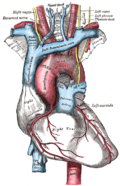 Location of the aortic body in relation to the aortic arch.

Ad. Transform your health with W8MD Weight Loss, Sleep & MedSpa

Tired of being overweight?
Special offer:
Budget GLP-1 weight loss medications
- Semaglutide starting from $29.99/week and up with insurance for visit of $59.99 and up per week self pay.
- Tirzepatide starting from $45.00/week and up (dose dependent) or $69.99/week and up self pay
✔ Same-week appointments, evenings & weekends
Learn more:
- GLP-1 weight loss clinic NYC
- W8MD's NYC medical weight loss
- W8MD Philadelphia GLP-1 shots
- Philadelphia GLP-1 injections
- Affordable GLP-1 shots NYC
|
WikiMD Medical Encyclopedia |
Medical Disclaimer: WikiMD is for informational purposes only and is not a substitute for professional medical advice. Content may be inaccurate or outdated and should not be used for diagnosis or treatment. Always consult your healthcare provider for medical decisions. Verify information with trusted sources such as CDC.gov and NIH.gov. By using this site, you agree that WikiMD is not liable for any outcomes related to its content. See full disclaimer.
Credits:Most images are courtesy of Wikimedia commons, and templates, categories Wikipedia, licensed under CC BY SA or similar.
Translate this page: - East Asian
中文,
日本,
한국어,
South Asian
हिन्दी,
தமிழ்,
తెలుగు,
Urdu,
ಕನ್ನಡ,
Southeast Asian
Indonesian,
Vietnamese,
Thai,
မြန်မာဘာသာ,
বাংলা
European
español,
Deutsch,
français,
Greek,
português do Brasil,
polski,
română,
русский,
Nederlands,
norsk,
svenska,
suomi,
Italian
Middle Eastern & African
عربى,
Turkish,
Persian,
Hebrew,
Afrikaans,
isiZulu,
Kiswahili,
Other
Bulgarian,
Hungarian,
Czech,
Swedish,
മലയാളം,
मराठी,
ਪੰਜਾਬੀ,
ગુજરાતી,
Portuguese,
Ukrainian
