Mince pie
Mince Pie
A Mince Pie is a traditional British festive dish, typically consumed during the Christmas season. The pie is filled with mincemeat, a mixture of dried fruits and spices, often with a dash of brandy or rum. Despite its name, modern mince pies rarely contain any meat, although historically, they did include a small amount of minced meat.
History
The origins of the mince pie can be traced back to the 13th century, when returning European crusaders brought back Middle Eastern recipes containing meats, fruits, and spices. These ingredients were used to make the early versions of the mince pie, then known as a 'Christmas pie'. The pie was originally oblong in shape, to represent the manger of the baby Jesus Christ, with the top representing his swaddling clothes.
Ingredients and Preparation
The primary ingredient of a mince pie is the mincemeat. Traditional mincemeat consists of a variety of dried fruits such as raisins, currants, and prunes, mixed with suet and spices like nutmeg, cinnamon, and cloves. Often, a splash of brandy or rum is added for extra flavor. This mixture is then encased in a pastry crust and baked until golden.
Modern mince pies may also include variations such as apple mince pies, where apples are added to the mincemeat, or vegetarian mince pies, where the suet is replaced with a vegetarian alternative.
Cultural Significance
Mince pies hold a significant place in British Christmas traditions. It is customary to leave a mince pie and a glass of brandy out for Santa Claus on Christmas Eve. There is also a superstition that says you should eat a mince pie on each of the 12 days of Christmas to bring good luck for the coming year.
See Also
| British cuisine |
|---|
 |
| National cuisines |
| Regional cuisines |
| Overseas/Fusion cuisine |
| People |

Mince pie
-
 Mince pies on a plate
 -
 William Henry Hunt Christmas pie
 -
 Mincemeat from Flickr user Stuart Caie
 -
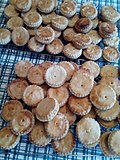 Mince pies December 2017


Ad. Transform your life with W8MD's
GLP-1 weight loss injections special from $29.99 with insurance
|
WikiMD Medical Encyclopedia |
Medical Disclaimer: WikiMD is for informational purposes only and is not a substitute for professional medical advice. Content may be inaccurate or outdated and should not be used for diagnosis or treatment. Always consult your healthcare provider for medical decisions. Verify information with trusted sources such as CDC.gov and NIH.gov. By using this site, you agree that WikiMD is not liable for any outcomes related to its content. See full disclaimer.
Credits:Most images are courtesy of Wikimedia commons, and templates, categories Wikipedia, licensed under CC BY SA or similar.
Translate this page: - East Asian
中文,
日本,
한국어,
South Asian
हिन्दी,
தமிழ்,
తెలుగు,
Urdu,
ಕನ್ನಡ,
Southeast Asian
Indonesian,
Vietnamese,
Thai,
မြန်မာဘာသာ,
বাংলা
European
español,
Deutsch,
français,
Greek,
português do Brasil,
polski,
română,
русский,
Nederlands,
norsk,
svenska,
suomi,
Italian
Middle Eastern & African
عربى,
Turkish,
Persian,
Hebrew,
Afrikaans,
isiZulu,
Kiswahili,
Other
Bulgarian,
Hungarian,
Czech,
Swedish,
മലയാളം,
मराठी,
ਪੰਜਾਬੀ,
ગુજરાતી,
Portuguese,
Ukrainian
