Cryosphere: Difference between revisions
CSV import |
CSV import |
||
| Line 35: | Line 35: | ||
{{Hydrology}} | {{Hydrology}} | ||
{{medicine-stub}} | {{medicine-stub}} | ||
== Cryosphere == | |||
<gallery> | |||
File:Cryosphere_Fuller_Projection.png|Cryosphere Fuller Projection | |||
File:Climate-system.jpg|Climate system | |||
File:1249_Finsteraarhorn.jpg|Finsteraarhorn | |||
File:Wildspitze_seen_from_Hinterer_Brunnkogel,_with_visible_ascent_track_of_ski_mountaineer.jpg|Wildspitze seen from Hinterer Brunnkogel, with visible ascent track of ski mountaineer | |||
File:Greenland-ice_sheet_hg.jpg|Greenland ice sheet | |||
File:Arctic_ice.jpg|Arctic ice | |||
File:Seaice.jpg|Sea ice | |||
File:Snow-covered_fir_trees.jpg|Snow-covered fir trees | |||
File:Long_Mynd_snowdrift.jpeg|Long Mynd snowdrift | |||
File:Beckmann_2023_Greenland_2300_RCP85_extent.png|Beckmann 2023 Greenland 2300 RCP85 extent | |||
</gallery> | |||
Latest revision as of 21:05, 23 February 2025
Cryosphere refers to the portions of Earth's surface where water is in solid form, including sea ice, lake ice, river ice, snow cover, glaciers, ice caps, ice sheets, and frozen ground (which includes permafrost). The cryosphere is an integral part of the global climate system, with important connections and feedbacks generated through its interactions with the atmosphere, ocean, and biosphere. The cryosphere plays a critical role in Earth's climate by reflecting solar radiation (albedo effect) and regulating surface temperature. It also contributes to global sea level rise through the melting of glaciers and ice sheets.
Components of the Cryosphere[edit]
Sea Ice[edit]
Sea ice forms from the freezing of ocean water. It affects the movement of ocean waters and is an important habitat for polar wildlife.
Glaciers and Ice Sheets[edit]
Glaciers are large, flowing masses of ice that form where the accumulation of snow exceeds its ablation (melting and sublimation) over many years. Ice sheets, found in Greenland and Antarctica, are continental-scale ice masses that cover land surface.
Permafrost[edit]
Permafrost is ground, including rock or soil, that has been frozen for more than two consecutive years. It plays a key role in the carbon cycle and can release greenhouse gases upon thawing.
Snow Cover[edit]
Snow cover refers to the layer of snow that accumulates on the ground in polar and temperate regions. It influences Earth's temperature by reflecting sunlight and insulating the surface.
Importance of the Cryosphere[edit]
The cryosphere influences the global climate system in several ways. It reflects a significant amount of solar radiation back into space, which helps to regulate Earth's temperature. The cryosphere also contributes to global sea level rise through the melting of ice. Additionally, it is a critical source of freshwater for many regions and supports diverse ecosystems.
Changes in the Cryosphere[edit]
Observations show that the cryosphere is undergoing significant changes due to global warming. These changes include the shrinking of glaciers, the thinning of ice sheets, the reduction of sea ice, and the thawing of permafrost. These changes have profound impacts on global sea levels, weather patterns, and ecosystems.
Challenges and Future Directions[edit]
The ongoing changes in the cryosphere present significant challenges for scientists, policymakers, and communities. Predicting the future state of the cryosphere requires sophisticated climate models and a comprehensive understanding of the complex interactions between the atmosphere, oceans, and ice. Efforts to mitigate the impacts of cryosphere changes include reducing greenhouse gas emissions, protecting vulnerable ecosystems, and developing adaptive strategies for communities at risk.
| Glaciology | ||||||||||
|---|---|---|---|---|---|---|---|---|---|---|
This glaciology related article is a stub.
|

Cryosphere[edit]
-
 Cryosphere Fuller Projection
 -
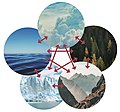 Climate system
 -
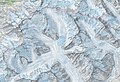 Finsteraarhorn
 -
 Wildspitze seen from Hinterer Brunnkogel, with visible ascent track of ski mountaineer
 -
 Greenland ice sheet
 -
 Arctic ice
 -
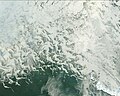 Sea ice
 -
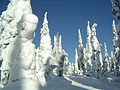 Snow-covered fir trees
 -
 Long Mynd snowdrift
 -
 Beckmann 2023 Greenland 2300 RCP85 extent


