Earth
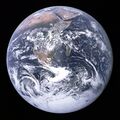
Earth is the third planet from the Sun and the only astronomical object known to harbor and support life. About 29.2% of Earth's surface is land consisting of continents and islands. The remaining 70.8% is covered with water, mostly by oceans, seas, gulfs, and other salt-water bodies, but also by lakes, rivers, and other freshwater, which together constitute the hydrosphere. Much of Earth's polar regions are covered in ice. Earth's outer layer is divided into several rigid tectonic plates that migrate across the surface over many millions of years, while its interior remains active with a solid iron inner core, a liquid outer core that generates Earth's magnetic field, and a convective mantle that drives plate tectonics.
Structure[edit]
Earth's structure can be viewed as consisting of four major parts: a solid inner core, a liquid outer core, a viscous mantle, and a silicate solid crust. This is layered according to density, with the least dense material on the surface and the most dense at the center.
Inner Core[edit]
The inner core, the hottest part of the Earth, is primarily a solid ball with a radius of about 1,220 kilometers (760 miles), according to seismological studies. It is believed to consist primarily of an iron–nickel alloy and to be approximately the same temperature as the surface of the Sun.
Outer Core[edit]
The outer core, about 2200 kilometers (1367 miles) thick, is mostly composed of liquid iron and nickel. The outer core, which has been confirmed to be liquid, surrounds the inner core and is believed to cause Earth's magnetic field.
Mantle[edit]
The mantle is located directly under the sima. It is composed of silicate rocks that are rich in iron and magnesium relative to the overlying crust. Although solid, the high temperatures within the mantle cause the silicate material to be sufficiently ductile that it can flow on very long timescales.
Crust[edit]
The crust ranges from 5–70 kilometers (3.1–43.5 mi) in depth and is the outermost layer. The thin parts are the oceanic crust, which underlie the ocean basins (5–10 km) and are composed of dense (mafic) iron magnesium silicate igneous rocks, like basalt.
Atmosphere[edit]
The atmosphere of Earth serves as a key factor in sustaining the planetary ecosystem. The thin layer of gases that envelops the Earth is held in place by gravity. Air is mostly nitrogen, oxygen, water vapor, with much smaller amounts of carbon dioxide, argon, etc.
Biosphere[edit]
The biosphere is the part of Earth's outer shell—including land, surface rocks, water, air and the atmosphere—within which life occurs, and which biotic processes in turn alter or transform.
See Also[edit]

This WikiMD article can only be edited by registered and verified editors. You can log in or register.
-
 Earth
Earth -
Earth
-
Earth
-
 Earth
Earth -
Earth
-
Earth
-
Earth
-
Earth
-
Earth
-
Earth
-
Earth
-
Earth


Advertise on WikiMD — 81,000+ full articles, ~900,000 total pages, ~250 million page views. Global reach, limited time promotional rates from $1/page/day. Learn more · View stats


Translate page: - East Asian
中文,
日本,
한국어,
South Asian
हिन्दी,
தமிழ்,
తెలుగు,
Urdu,
ಕನ್ನಡ,
Southeast Asian
Indonesian,
Vietnamese,
Thai,
မြန်မာဘာသာ,
বাংলা
European
español,
Deutsch,
français,
Greek,
português do Brasil,
polski,
română,
русский,
Nederlands,
norsk,
svenska,
suomi,
Italian
Middle Eastern & African
عربى,
Turkish,
Persian,
Hebrew,
Afrikaans,
isiZulu,
Kiswahili,
Other
Bulgarian,
Hungarian,
Czech,
Swedish,
മലയാളം,
मराठी,
ਪੰਜਾਬੀ,
ગુજરાતી,
Portuguese,
Ukrainian
About WikiMD • Contact • Disclaimer • Privacy • Copyright • Site statistics
Some content and images may originate from Wikimedia Commons or Wikipedia and remain subject to their stated licenses. Unless otherwise noted, eligible WikiMD content is available under CC BY-SA 4.0.
WikiMD Wellnesspedia — Free health & wellness information for patients, students, and health professionals.


.svg)


