Paleoclimatology
Paleoclimatology is the scientific study of Earth's climate over the entire course of its history. It uses a variety of techniques and methodologies to reconstruct past climates, and seeks to determine the mechanisms that caused the Earth to change from one climate state to another.
Overview[edit]
Paleoclimatology is a sub-discipline of climatology and is closely related to paleoecology, paleogeography, and geochronology. It uses a variety of proxy methods from the Earth and life sciences to obtain data previously preserved within things such as rocks, sediments, ice sheets, tree rings, corals, shells, and microfossils.
Techniques[edit]
Paleoclimatologists employ a wide range of techniques to deduce ancient climates.
Ice cores[edit]
Ice cores are one of the most effective, though not the only, methods of recreating long term climate records. Ice core data from Greenland and Antarctica has been crucial in the study of Quaternary climate and the glacial/interglacial cycles.
Sediment cores[edit]
Sediment cores are often analyzed to reveal the climate data of the past. The ratio of oxygen isotopes (18O/16O) present in the sediments can be used to identify changes in temperature and ice volume.
Dendroclimatology[edit]
Dendroclimatology is the study of tree ring growth and the factors that influence the growth. It can provide information about regional and local climate changes.
Major periods studied[edit]
Paleoclimatology studies numerous periods of Earth's history, including the Cretaceous warm period, the Paleocene-Eocene Thermal Maximum, the Pleistocene ice ages, and the Holocene interglacial period.
See also[edit]
References[edit]
<references />
 | This article about atmospheric science is a stub. You can help WikiMD by expanding the page. |
-
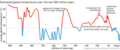 Earth's average surface temperature over the past 500 million years
 -
 All palaeotemps
 -
 Sauerstoffgehalt over 1000 million years
 -
 Core Repository core samples
 -
 Glaciations in Earth's existence
 -
 Phanerozoic Climate Change
 -
 EDC Temperature, CO2, and Dust
 -
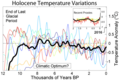 Holocene Temperature Variations


Medical Disclaimer: WikiMD is for informational purposes only and is not a substitute for professional medical advice. Content may be inaccurate or outdated and should not be used for diagnosis or treatment. Always consult your healthcare provider for medical decisions. Verify information with trusted sources such as CDC.gov and NIH.gov. By using this site, you agree that WikiMD is not liable for any outcomes related to its content. See full disclaimer.
Credits:Most images are courtesy of Wikimedia commons, and templates, categories Wikipedia, licensed under CC BY SA or similar.
Translate this page: - East Asian
中文,
日本,
한국어,
South Asian
हिन्दी,
தமிழ்,
తెలుగు,
Urdu,
ಕನ್ನಡ,
Southeast Asian
Indonesian,
Vietnamese,
Thai,
မြန်မာဘာသာ,
বাংলা
European
español,
Deutsch,
français,
Greek,
português do Brasil,
polski,
română,
русский,
Nederlands,
norsk,
svenska,
suomi,
Italian
Middle Eastern & African
عربى,
Turkish,
Persian,
Hebrew,
Afrikaans,
isiZulu,
Kiswahili,
Other
Bulgarian,
Hungarian,
Czech,
Swedish,
മലയാളം,
मराठी,
ਪੰਜਾਬੀ,
ગુજરાતી,
Portuguese,
Ukrainian
