Quackery: Difference between revisions
No edit summary |
CSV import |
||
| Line 44: | Line 44: | ||
[[Category:Ignorance]] | [[Category:Ignorance]] | ||
[[Category:Deception]] | [[Category:Deception]] | ||
<gallery> | |||
File:WPA quack poster.jpg|Quackery | |||
File:Marriage A-la-Mode 3, The Inspection - William Hogarth.jpg|Quackery | |||
File:Bemberg Fondation Toulouse - Le Charlatan - Pietro Longhi - Inv 1029.jpg|Quackery | |||
File:Hemessen-cirujano-prado.jpg|Quackery | |||
File:Three early medicine bottles.jpg|Quackery | |||
File:Clark Stanley's Snake Oil Liniment.png|Quackery | |||
File:Magnetiseur.JPG|Quackery | |||
File:Electro-metabograph machine.jpg|Quackery | |||
File:Tho-Radia-IMG 1228.JPG|Quackery | |||
File:Scientology - The E-Meter.jpg|Quackery | |||
File:Revigorator.jpg|Quackery | |||
File:David Teniers II - The Consultation (c.1660).jpg|Quackery | |||
</gallery> | |||
Latest revision as of 01:13, 20 February 2025
Quackery is the promotion of fraudulent or ignorant medical practices. Often characterized by health-related scams and frauds, quackery can involve the sale of products and services that have no proven, or possibly even potential, medicinal benefit. These practices can range from ineffectual to harmful or deadly, exploiting a patient's lack of medical knowledge or desperation for a cure. Quackery can be identified through its disregard for scientific methodology in diagnosing or treating diseases. Practices may involve the sale of unproven "miracle cures," ineffective treatments, or the deliberate misrepresentation of the abilities of certain medical devices or techniques.
History[edit]
Historically, quackery was commonplace, largely due to a lack of scientific understanding and regulation in the field of medicine. Over time, with the advancement of medical research and regulatory bodies, quackery has become less prevalent, although it continues to exist, often exploiting new or misunderstood areas of medicine.
Forms of Quackery[edit]
Quackery can take many forms, including:
Health Fraud[edit]
This involves selling products or services that claim to prevent, treat, or cure diseases or other health conditions, but are not proven safe and effective for those uses.
Miracle Cures[edit]
These are unproven treatment claims that are generally heralded as a miracle cure for a range of health conditions.
Charlatanism[edit]
Charlatanism refers to individuals, known as "charlatans," who fraudulently claim to have medical skills or knowledge they do not possess.
Consequences of Quackery[edit]
The potential damage from quackery can be significant. Not only can patients waste money on ineffective treatments, but they may also delay seeking proper medical attention, leading to worsening of their condition.
Detection and Prevention[edit]
Awareness and education are key in preventing quackery. Regulatory agencies like the U.S. Food and Drug Administration (FDA) and Federal Trade Commission (FTC) monitor and take action against deceptive health claims.
References[edit]
- American Cancer Society. "Quackery or Over-the-Counter Medicine". Retrieved 19 June 2023.
- National Institute of Health. "Spotting Quackery". Retrieved 19 June 2023.
- U.S. Food and Drug Administration. "Health Fraud Scams". Retrieved 19 June 2023.
 | |
|---|---|
 |
 |
| Types of fraud | ||||||||||
|---|---|---|---|---|---|---|---|---|---|---|
|
-
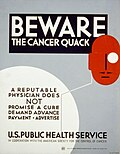 Quackery
 -
 Quackery
 -
 Quackery
 -
 Quackery
 -
 Quackery
 -
 Quackery
 -
 Quackery
 -
 Quackery
 -
 Quackery
 -
 Quackery
 -
 Quackery
 -
 Quackery


.jpg)
