Proofing (baking technique): Difference between revisions
CSV import Tags: mobile edit mobile web edit |
CSV import |
||
| Line 29: | Line 29: | ||
{{Cooking techniques}} | {{Cooking techniques}} | ||
{{food-stub}} | {{food-stub}} | ||
<gallery> | |||
File:Loaf_pans.JPG|Loaf pans used for proofing bread | |||
File:Proofingcrois.jpg|Croissants proofing | |||
File:Breaddough1.jpg|Bread dough in the early stages of proofing | |||
File:Breaddough2.jpg|Bread dough after proofing | |||
File:Home_Bread_Proofer.jpg|Home bread proofer | |||
File:Commerciale_proofing_room.jpg|Commercial proofing room | |||
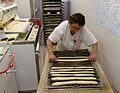
File:M0354_57-6-107_1.jpg|Proofing (baking technique) | |||
File:8_couche.jpg|Dough resting on a couche | |||
</gallery> | |||
Latest revision as of 11:16, 18 February 2025
Proofing (also known as proving or fermentation) is a step in the preparation of yeast bread and other baked goods where the dough is allowed to rest and rise a final time before baking. During this rest period, yeast ferments the dough and produces gases, thereby leavening the dough.
History[edit]
The process of proofing has been used in baking for thousands of years. The earliest forms of bread were likely flatbreads, but with the discovery of yeast, the process of fermentation, and thus proofing, was introduced. This allowed for the creation of lighter, airier breads.
Process[edit]
Proofing uses the fermentation process to allow dough to rise. Yeast, a key ingredient in many doughs, consumes sugars and excretes carbon dioxide and alcohol. When dough is mixed and kneaded, tiny pockets of air are introduced. During proofing, the yeast's production of carbon dioxide gas inflates these air pockets, causing the dough to rise.
The proofing process also contributes to the flavor of the bread. As the yeast ferments the sugars, it produces alcohol and other byproducts that give bread its distinctive taste.
Proofing Methods[edit]
There are several methods of proofing used in baking. The most common is bulk fermentation, where the dough is allowed to rise in a large container before it is shaped. Another method is final proofing, where the dough is shaped into its final form and then allowed to rise. Some bakers use a proofing basket or banneton to help the dough maintain its shape during final proofing.
A proofing box or proofer is a piece of equipment that provides a controlled environment for proofing. It maintains a consistent temperature and humidity level to ensure the dough rises properly.
Factors Affecting Proofing[edit]
Several factors can affect the proofing process, including the temperature, humidity, and the amount of yeast in the dough. Dough will rise faster in a warm, humid environment, but if the temperature is too high, the yeast may die. Similarly, if there is too much or too little yeast, the dough may not rise properly.
See Also[edit]
| Baking | ||||||||||
|---|---|---|---|---|---|---|---|---|---|---|
|
| Cooking techniques | ||||||||||||||||||||||||||||||
|---|---|---|---|---|---|---|---|---|---|---|---|---|---|---|---|---|---|---|---|---|---|---|---|---|---|---|---|---|---|---|
|

-
 Loaf pans used for proofing bread
 -
 Croissants proofing
 -
 Bread dough in the early stages of proofing
 -
 Bread dough after proofing
 -
 Home bread proofer
 -
 Commercial proofing room
 -
 Proofing (baking technique)
 -
 Dough resting on a couche


