Pastry


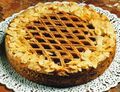
Pastry is a dough of flour, water and shortening (solid fats, including butter) that may be savoury or sweetened. Sweetened pastries are often described as bakers' confectionery. The word "pastries" suggests many kinds of baked products made from ingredients such as flour, sugar, milk, butter, shortening, baking powder, and eggs. Small tarts and other sweet baked products are called pastries. Common pastry dishes include pies, tarts, quiches, and pasties.
Types of Pastry[edit]
The main types of pastry are:
- Shortcrust pastry: The simplest and most common pastry. It is made with flour, fat, and water to bind the dough. This is used for tarts, pies, and quiches.
- Puff pastry: Made with several layers of fat which are folded into the dough to create a flaky, light pastry after baking. It is used for pastries like croissants, Danish pastries, and vol-au-vents.
- Choux pastry: A light pastry dough used to make éclairs, cream puffs, and profiteroles. It employs high moisture content to create steam during cooking to puff the pastry.
- Filo pastry: A very thin unleavened dough used for making pastries like baklava and börek in Middle Eastern and Balkan cuisines.
- Hot water crust pastry: A type of pastry used for savory pies, such as pork pies, game pies, and, more rarely, steak and kidney pies. Hot water crust is traditionally used for making hand-raised pies.
Ingredients[edit]
The primary ingredients in pastry making include:
- Flour: The basic structure of the pastry. Wheat flour is the most common type used.
- Fats: Including butter, lard, or vegetable shortening. Fats are incorporated into the dough to give the pastry its texture.
- Liquids: Water, milk, or eggs are used to bind the dough and affect the tenderness and flakiness of the finished product.
- Sugar: Added for sweetness and to tenderize the pastry.
- Leavening agents: Such as baking powder or yeast, may be used in some pastries to produce a lighter, airier texture.
Preparation and Techniques[edit]
Pastry making involves various techniques that affect the texture and flavor of the finished product. These include:
- Rubbing in: A method where fat is rubbed into the flour before adding any liquid to make breadcrumbs-like texture.
- Folding: Used in making puff pastry, where the dough is repeatedly folded and rolled to create layers.
- Blind baking: Pre-baking the pastry crust before adding the filling to prevent it from becoming soggy.
- Glazing: Applying egg or milk wash before baking to give the pastry a golden and glossy finish.
Cultural Significance[edit]
Pastry has a significant place in various cultures around the world, with each having its unique variations and specialties. For example, in France, pastries like croissants and éclairs are an integral part of the cuisine. In the Middle East, pastries such as baklava are traditionally served during festive occasions.
See Also[edit]

-
 Pastry
 -
 Pastry
 -
 Pastry
 -
 Pastry
 -
 Pastry
 -
 Pastry


.jpg)


Sponsored Health Resource

W8MD Weight Loss, Sleep & MedSpa
Looking for physician-supervised weight loss, semaglutide, tirzepatide, or GLP-1 receptor agonist options? W8MD helps eligible patients in New York City, Brooklyn, New Jersey, Connecticut, Pennsylvania, Delaware, and greater Philadelphia with medical weight loss, sleep medicine, and long-term maintenance support.
GLP-1 specials: Affordable GLP-1 injections NYC and Philadelphia starting from $29.99/week and up for semaglutide with insurance accepted for qualifying visits, and $45/week and up for tirzepatide with insurance accepted for qualifying visits. Self-pay options start from $59.99/week and up for semaglutide and $69.99/week and up for tirzepatide.
- Medical weight loss NYC
- Affordable GLP-1 injections NYC
- Budget GLP-1 weight loss shots Philadelphia
- New Jersey medical weight loss
- NYC medical weight loss blog
- Philadelphia weight loss blog
- Sleep medicine and sleep apnea services
- W8MD MedSpa and wellness
Book a W8MD appointment · View GLP-1 specials
Paid promotional message. Eligibility, pricing, insurance coverage, medication availability, and results vary. Medical evaluation required.

Medical Disclaimer: WikiMD is for informational purposes only and is not a substitute for professional medical advice. Content may be inaccurate or outdated and should not be used for diagnosis or treatment. Always consult your healthcare provider for medical decisions. Verify information with trusted sources such as CDC.gov and NIH.gov. By using this site, you agree that WikiMD is not liable for any outcomes related to its content. See full disclaimer.
Credits:Most images are courtesy of Wikimedia commons, and templates, categories Wikipedia, licensed under CC BY SA or similar.
Translate page: - East Asian
中文,
日本,
한국어,
South Asian
हिन्दी,
தமிழ்,
తెలుగు,
Urdu,
ಕನ್ನಡ,
Southeast Asian
Indonesian,
Vietnamese,
Thai,
မြန်မာဘာသာ,
বাংলা
European
español,
Deutsch,
français,
Greek,
português do Brasil,
polski,
română,
русский,
Nederlands,
norsk,
svenska,
suomi,
Italian
Middle Eastern & African
عربى,
Turkish,
Persian,
Hebrew,
Afrikaans,
isiZulu,
Kiswahili,
Other
Bulgarian,
Hungarian,
Czech,
Swedish,
മലയാളം,
मराठी,
ਪੰਜਾਬੀ,
ગુજરાતી,
Portuguese,
Ukrainian

