Pindolol: Difference between revisions
Created page with "{{intro}} Pindolol is a nonselective beta adrenergic receptor blocker that is widely used for the therapy of hypertension and angina pectoris. {{livtox}} Pindolol has ye..." |
CSV import |
||
| Line 20: | Line 20: | ||
{{antihypertensives}} | {{antihypertensives}} | ||
{{coststubd}} | {{coststubd}} | ||
<gallery> | |||
File:Pindolol.svg|Chemical structure of Pindolol | |||
File:Pindolol-3D-spacefill.png|3D space-filling model of Pindolol | |||
</gallery> | |||
Latest revision as of 02:07, 17 February 2025
Information about Pindolol[edit]
Pindolol is a nonselective beta adrenergic receptor blocker that is widely used for the therapy of hypertension and angina pectoris.
Liver safety of Pindolol[edit]
Pindolol has yet to be convincingly associated with clinically apparent liver injury.
Mechanism of action of Pindolol[edit]
Pindolol (pin' doe lol) is a nonselective beta blocker, acting on both beta-1 and beta-2 adrenergic receptors. Beta-1 adrenergic blockade reduces the heart rate and myocardial contractility by slowing the AV conduction and suppressing automaticity. Beta-2 blockade affects peripheral vascular resistance and can cause bronchospasm and hypoglycemia. Pindolol is also a partial adrenergic receptor agonist and has mild sympathomimetic activity.
FDA approval information for Pindolol[edit]
Pindolol was approved for use in the United States in 1982 and remains in wide use, current indications being treatment of hypertension either alone or in combination with other antihypertensive medications. Pindolol is available in tablets of 5 and 10 mg in generic forms and under the trade name Visken.
Dosage and administration for Pindolol[edit]
The typical initial oral dose of pindolol in adults is 5 mg twice daily, with subsequent dose modification based upon clinical response and tolerance, the average total daily maintenance dose being 10 to 60 mg.
Side effects of Pindolol[edit]
Common side effects of pindolol include bradycardia, hypotension, fatigue, dizziness, depression, memory loss, incontinence, cold limbs and, less commonly, severe hypotension, heart failure and bronchospasm. Sudden withdrawal can trigger rebound hypertension. Beta-blockers are contraindicated in patients with asthma, bradycardia and heart failure and should be used cautiously in the elderly and in patients with diabetes.
| Beta blockers (C07) | ||||||||
|---|---|---|---|---|---|---|---|---|
|
-
 Chemical structure of Pindolol
 -
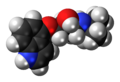 3D space-filling model of Pindolol


