Dihydrocodeine: Difference between revisions
CSV import |
CSV import |
||
| Line 66: | Line 66: | ||
[[Category:Analgesics]] | [[Category:Analgesics]] | ||
[[Category:Antitussives]] | [[Category:Antitussives]] | ||
<gallery> | |||
File:Dihydrocodeine skeletal.svg|Dihydrocodeine skeletal structure | |||
File:Dihydrocodeine3DanJ.gif|Dihydrocodeine 3D animation | |||
</gallery> | |||
Latest revision as of 01:01, 20 February 2025
An opioid analgesic used for pain management
| Dihydrocodeine | |
|---|---|

| |
| INN | |
| Drug class | |
| Routes of administration | Oral, subcutaneous, intramuscular |
| Pregnancy category | |
| Bioavailability | 20% (oral) |
| Metabolism | Hepatic |
| Elimination half-life | 3.5–5 hours |
| Excretion | Renal |
| Legal status | |
| CAS Number | 125-28-0 |
| PubChem | 5284543 |
| DrugBank | DB01551 |
| ChemSpider | 4447628 |
| KEGG | D07880 |
Dihydrocodeine is a semi-synthetic opioid analgesic prescribed for the relief of moderate to severe pain. It is also used as an antitussive to suppress cough. Dihydrocodeine is a hydrogenated derivative of codeine, and it is available in various formulations, including tablets, elixirs, and injectable solutions.
Pharmacology[edit]
Dihydrocodeine acts primarily as an agonist at the mu-opioid receptor, which is responsible for its analgesic effects. It also has some affinity for the delta-opioid receptor and kappa-opioid receptor, contributing to its overall pharmacological profile. The drug is metabolized in the liver by the cytochrome P450 enzyme system, primarily CYP2D6, into active metabolites such as dihydromorphine.
Mechanism of Action[edit]
The analgesic effects of dihydrocodeine are mediated through its action on the central nervous system, where it binds to opioid receptors and inhibits the transmission of pain signals. This results in an increased pain threshold and altered perception of pain.
Medical Uses[edit]
Dihydrocodeine is indicated for the management of moderate to severe pain, particularly when other analgesics such as paracetamol or nonsteroidal anti-inflammatory drugs (NSAIDs) are insufficient. It is also used as a cough suppressant in certain formulations.
Dosage and Administration[edit]
The dosage of dihydrocodeine varies depending on the formulation and the severity of the condition being treated. It is typically administered orally, but can also be given via subcutaneous or intramuscular injection. The usual adult dose ranges from 30 mg to 60 mg every 4 to 6 hours as needed for pain.
Side Effects[edit]
Common side effects of dihydrocodeine include nausea, vomiting, constipation, drowsiness, and dizziness. As with other opioids, there is a risk of respiratory depression, particularly at higher doses or in combination with other central nervous system depressants.
Precautions[edit]
Dihydrocodeine should be used with caution in patients with a history of substance abuse, respiratory disorders, or hepatic impairment. It is classified as a Schedule II controlled substance in the United States, indicating a high potential for abuse and dependence.
Related Pages[edit]
-
 Dihydrocodeine skeletal structure
 -
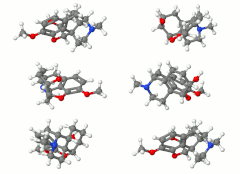 Dihydrocodeine 3D animation


