Berberis aristata: Difference between revisions
CSV import Tags: mobile edit mobile web edit |
CSV import |
||
| Line 27: | Line 27: | ||
{{Ayurvedic medicinals}} | {{Ayurvedic medicinals}} | ||
{{food-stub}} | {{food-stub}} | ||
<gallery> | |||
Berberis aristata | |||
File:BerberisAculeata.jpg|Berberis Aculeata | |||
File:Berberis aristata fruit.jpg|Berberis aristata fruit | |||
File:Berberin.svg|Berberin | |||
</gallery> | |||
Revision as of 05:25, 3 March 2025
Berberis aristata, also known as Indian Barberry or Tree Turmeric, is a shrub belonging to the family Berberidaceae. It is native to the Himalayas in India and Nepal, and is also found in the Nilgiri Mountains in South India.
Description
Berberis aristata is a deciduous shrub that can grow up to 3.5 meters high. The plant has a grey, deeply cracked bark and spiny leaves. The flowers are yellow and the fruit is a berry that turns red when ripe. The roots of the plant are thick and have a yellow color.
Uses
Berberis aristata has a long history of use in Ayurveda, a traditional system of medicine in India. It is used in the treatment of various diseases such as skin diseases, liver disorders, and eye infections. The plant is also used in the production of dyes due to its yellow wood.
Cultivation
Berberis aristata is a hardy plant that can grow in a variety of soil types, but prefers well-drained soil. It can tolerate both full sun and partial shade. The plant is propagated by seeds, cuttings, or by division of the roots.
Research
Research has shown that Berberis aristata has various medicinal properties. It has been found to have anti-inflammatory, antibacterial, antifungal, and antioxidant properties. The plant is also being studied for its potential use in the treatment of diabetes and cancer.
Conservation
Berberis aristata is not currently considered to be at risk of extinction. However, due to its medicinal value, the plant is often harvested from the wild, which could potentially lead to its decline in the future.
See also
| Medicinal plants | ||||||||
|---|---|---|---|---|---|---|---|---|
This medicinal plants related article is a stub.
|

-
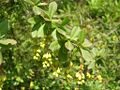 Berberis Aculeata
 -
 Berberis aristata fruit
 -
 Berberin


