Anal triangle: Difference between revisions
From WikiMD's Medical Encyclopedia
CSV import |
CSV import |
||
| Line 6: | Line 6: | ||
File:Gray1077.png|Anal triangle | File:Gray1077.png|Anal triangle | ||
</gallery> | </gallery> | ||
==Anal Triangle== | |||
The '''anal triangle''' is a significant anatomical region located in the perineum, which is the area between the thighs that includes the external genitalia and the anus. The anal triangle is one of the two triangles that make up the perineum, the other being the [[urogenital triangle]]. | |||
==Anatomy== | |||
The anal triangle is defined by specific anatomical boundaries: | |||
* '''Anteriorly''': It is bounded by the imaginary line connecting the ischial tuberosities, which also serves as the posterior boundary of the [[urogenital triangle]]. | |||
* '''Posteriorly''': It is bounded by the tip of the [[coccyx]]. | |||
* '''Laterally''': It is bounded by the sacrotuberous ligaments, which run from the sacrum to the ischial tuberosities. | |||
The anal triangle contains the [[anal canal]], the [[anus]], and the surrounding [[ischioanal fossa]]. | |||
==Contents== | |||
The primary contents of the anal triangle include: | |||
* '''Anal Canal''': The terminal part of the [[gastrointestinal tract]], which is responsible for the expulsion of feces from the body. It is surrounded by the internal and external [[anal sphincters]]. | |||
* '''Anus''': The external opening of the anal canal. | |||
* '''Ischioanal Fossa''': A fat-filled space located on either side of the anal canal. It allows for the expansion of the anal canal during defecation and contains important neurovascular structures. | |||
==Muscles== | |||
The anal triangle is associated with several important muscles: | |||
* '''External Anal Sphincter''': A voluntary muscle that encircles the anal canal and is responsible for maintaining continence. | |||
* '''Levator Ani''': Part of the [[pelvic floor]] muscles, it supports the pelvic organs and assists in maintaining continence. | |||
==Clinical Significance== | |||
The anal triangle is clinically significant for several reasons: | |||
* '''Hemorrhoids''': Swollen veins in the anal canal that can cause discomfort and bleeding. | |||
* '''Anal Fissures''': Small tears in the lining of the anal canal, often causing pain during bowel movements. | |||
* '''Abscesses and Fistulas''': Infections in the anal region can lead to the formation of abscesses and fistulas, which may require surgical intervention. | |||
==Related Pages== | |||
* [[Perineum]] | |||
* [[Urogenital triangle]] | |||
* [[Pelvic floor]] | |||
* [[Anal canal]] | |||
* [[Ischioanal fossa]] | |||
{{Anatomy}} | |||
[[Category:Anatomy]] | |||
[[Category:Pelvis]] | |||
Latest revision as of 00:41, 19 February 2025
-
 Muscle of the Male Perineum
 -
 Muscle of the Female Perineum
 -
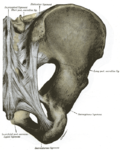 Anal triangle
 -
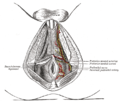 Anal triangle
 -
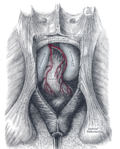 Anal triangle


Anal Triangle[edit]
The anal triangle is a significant anatomical region located in the perineum, which is the area between the thighs that includes the external genitalia and the anus. The anal triangle is one of the two triangles that make up the perineum, the other being the urogenital triangle.
Anatomy[edit]
The anal triangle is defined by specific anatomical boundaries:
- Anteriorly: It is bounded by the imaginary line connecting the ischial tuberosities, which also serves as the posterior boundary of the urogenital triangle.
- Posteriorly: It is bounded by the tip of the coccyx.
- Laterally: It is bounded by the sacrotuberous ligaments, which run from the sacrum to the ischial tuberosities.
The anal triangle contains the anal canal, the anus, and the surrounding ischioanal fossa.
Contents[edit]
The primary contents of the anal triangle include:
- Anal Canal: The terminal part of the gastrointestinal tract, which is responsible for the expulsion of feces from the body. It is surrounded by the internal and external anal sphincters.
- Anus: The external opening of the anal canal.
- Ischioanal Fossa: A fat-filled space located on either side of the anal canal. It allows for the expansion of the anal canal during defecation and contains important neurovascular structures.
Muscles[edit]
The anal triangle is associated with several important muscles:
- External Anal Sphincter: A voluntary muscle that encircles the anal canal and is responsible for maintaining continence.
- Levator Ani: Part of the pelvic floor muscles, it supports the pelvic organs and assists in maintaining continence.
Clinical Significance[edit]
The anal triangle is clinically significant for several reasons:
- Hemorrhoids: Swollen veins in the anal canal that can cause discomfort and bleeding.
- Anal Fissures: Small tears in the lining of the anal canal, often causing pain during bowel movements.
- Abscesses and Fistulas: Infections in the anal region can lead to the formation of abscesses and fistulas, which may require surgical intervention.
Related Pages[edit]
| Anatomy and morphology | ||||||||||
|---|---|---|---|---|---|---|---|---|---|---|
|
