The Hyoid Bone: Difference between revisions
No edit summary Tag: visualeditor-wikitext |
CSV import |
||
| (3 intermediate revisions by 2 users not shown) | |||
| Line 1: | Line 1: | ||
[[Anatomy]] > [[Gray's Anatomy| Gray's Anatomy of the Human Body]] > II. [Osteology > 5b. 9. The Hyoid Bone | [[Anatomy]] > [[Gray's Anatomy| Gray's Anatomy of the Human Body]] > II. [Osteology > 5b. 9. The Hyoid Bone | ||
| Line 22: | Line 20: | ||
In early life the '''lateral borders''' are connected to the greater [[cornua]] by [[synchondroses]]; after middle life usually by bony union. | In early life the '''lateral borders''' are connected to the greater [[cornua]] by [[synchondroses]]; after middle life usually by bony union. | ||
[[File:Gray186.png|thumb|FIG. 186– Hyoid bone. Anterior surface. Enlarged. (''Picture From the Classic Gray's Anatomy'')]] | |||
FIG. 186– Hyoid bone. Anterior surface. Enlarged. (''Picture From the Classic Gray's Anatomy'') | |||
=== '''The Greater Cornua or Thyrohyals (''cornua majora'')''' === | === '''The Greater Cornua or Thyrohyals (''cornua majora'')''' === | ||
| Line 62: | Line 56: | ||
{{Bones of skeleton}} | {{Bones of skeleton}} | ||
{{Portal bar|Anatomy}} | {{Portal bar|Anatomy}} | ||
{{DEFAULTSORT:Hyoid Bone}} | {{DEFAULTSORT:Hyoid Bone}} | ||
[[Category:Human head and neck]] | [[Category:Human head and neck]] | ||
[[Category:Irregular bones]] | [[Category:Irregular bones]] | ||
{{grays}} | {{grays}} | ||
__NOINDEX__ | |||
Latest revision as of 01:25, 30 March 2025
Anatomy > Gray's Anatomy of the Human Body > II. [Osteology > 5b. 9. The Hyoid Bone
Henry Gray (1821–1865). Anatomy of the Human Body. 1918.
The Hyoid Bone[edit]
(Os Hyoideum; Lingual Bone)
The hyoid bone is shaped like a horseshoe, and is suspended from the tips of the styloid processes of the temporal bones by the stylohyoid ligaments. It consists of five segments, viz., a body two greater cornua and two lesser cornua
The Body or Basihyal (corpus oss. hyoidei)[edit]
The body or central part is of a quadrilateral form. Its anterior surface (Fig. 186) is convex and directed forward and upward. It is crossed in its upper half by a well-marked transverse ridge with a slight downward convexity, and in many cases a vertical median ridge divides it into two lateral halves. The portion of the vertical ridge above the transverse line is present in a majority of specimens, but the lower portion is evident only in rare cases. The anterior surface gives insertion to the Geniohyoideus in the greater part of its extent both above and below the transverse ridge; a portion of the origin of the Hyoglossus notches the lateral margin of the Geniohyoideus attachment. Below the transverse ridge the Mylohyoideus, Sternohyoideus, and Omohyoideus are inserted.
The posterior surface is smooth, concave, directed backward and downward, and separated from the epiglottis by the hyothyroid membrane and a quantity of loose areolar tissue; a bursa intervenes between it and the hyothyroid membrane.
The superior border is rounded, and gives attachment to the hyothyroid membrane and some aponeurotic fibers of the Genioglossus.
The inferior border affords insertion medially to the Sternohyoideus and laterally to the Omohyoideus and occasionally a portion of the Thyreohyoideus. It also gives attachment to the Levator glandulae thyreoideae, when this muscle is present.
In early life the lateral borders are connected to the greater cornua by synchondroses; after middle life usually by bony union.

The Greater Cornua or Thyrohyals (cornua majora)[edit]
The greater cornua project backward from the lateral borders of the body; they are flattened from above downward and diminish in size from before backward; each ends in a tubercle to which is fixed the lateral hyothyroid ligament.
The upper surface is rough close to its lateral border, for muscular attachments: the largest of these are the origins of the Hyoglossus and Constrictor pharyngis medius which extend along the whole length of the cornu; the Digastricus and Stylohyoideus have small insertions in front of these near the junction of the body with the cornu.
To the medial border the hyothyroid membrane is attached, while the anterior half of the lateral border gives insertion to the Thyreohyoideus.
The Lesser Cornua or Ceratohyals (cornua minora)[edit]
The lesser cornu are two small, conical eminences, attached by their bases to the angles of junction between the body and greater cornua.
They are connected to the body of the bone by fibrous tissue, and occasionally to the greater cornua by distinct diarthrodial joints, which usually persist throughout life, but occasionally become ankylosed.
The lesser cornua are situated in the line of the transverse ridge on the body and appear to be morphological continuations of it (Parsons 46). The apex of each cornu gives attachment to the stylohyoid ligament; the Chondroglossus rises from the medial side of the base.
Ossification[edit]
The hyoid is ossified from six centers: two for the body, and one for each cornu. Ossification commences in the greater cornua toward the end of fetal life, in the body shortly afterward, and in the lesser cornua during the first or second year after birth.
Note 46 See article on “The Topography and Morphology of the Human Hyoid Bone,” by F. G. Parsons, Journal of Anatomy and Physiology, vol. xliii.
Note 47 These ligaments in many animals are distinct bones, and in man may undergo partial ossification.
Function[edit]

The hyoid bone is present in many mammals. It allows a wider range of tongue, pharyngeal and laryngeal movements by bracing these structures alongside each other in order to produce variation.<ref>,
 Archived copy,
 Proceedings of the National Academy of Sciences,
 2003,
 Vol. 100,
 pp. 6930–6933,
 DOI: 10.1073/pnas.1231107100,
 PMID: 12775758,
 PMC: 165807,

 Full text, Descent of the larynx in chimpanzee infants</ref> Its descent in living creatures is not unique to Homo sapiens,<ref>,
 Descent of the hyoid in chimpanzees: evolution of face flattening and speech,
 Journal of Human Evolution,
 2006,
 Vol. 51,
 pp. 244–254,
 DOI: 10.1016/j.jhevol.2006.03.005,
 PMID: 16730049,</ref> and does not allow the production of a wide range of sounds: with a lower larynx, men do not produce a wider range of sounds than women and 2-year-old babies. Moreover, the larynx position of Neanderthals was not a handicap to producing speech sounds.<ref>,
 The potential of Neandertal vowel space was as large as that of modern humans,
 Journal of Phonetics,
 2002,
 Vol. 30,
 pp. 465–484,
 DOI: 10.1006/jpho.2002.0170,</ref>   The discovery of a modern-looking hyoid bone of a Neanderthal man in the Kebara Cave in Israel led its discoverers to argue that the Neanderthals had a descended larynx, and thus human-like speech capabilities.<ref>Arsenburg, B. et al., A reappraisal of the anatomical basis for speech in middle Paleolithic hominids, in: American Journal of Physiological Anthropology 83 (1990), pp. 137–146.</ref>  However, other researchers have claimed that the morphology of the hyoid is not indicative of the larynx's position.<ref>Fitch, Tecumseh W., The evolution of speech: a comparative review, in: Trends in Cognitive Sciences, Vol. 4, No. 7, July 2000 (
Archived copy(link). {{{website}}}.
)</ref> It is necessary to take into consideration the skull base, the mandible and the cervical vertebrae and a cranial reference plane.<ref>,
 Hyoid bone and larynx in Homo. Estimated position by biometrics,
 Biom. Hum. et Anthropolol,
 2006,
 Vol. 24(Issue: 3–4),
 pp. 243–255,</ref><ref>,
 Variation and prediction of the hyoid bone position for modern Man and Neanderthal,
 Biom. Hum. et Anthropolol,
 2006,
 Vol. 24(Issue: 3–4),
 pp. 257–271,</ref>
Additional images[edit]
-
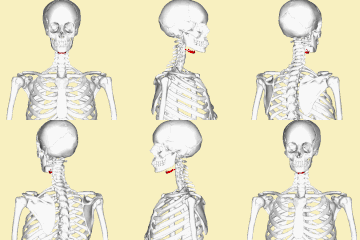 Position of hyoid bone (shown in red).
 -
 Shape of hyoid bone.


External links[edit]

- Lesson11 at The Anatomy Lesson by Wesley Norman (Georgetown University)
(larynxskel1
)
| Bones in the human skeleton | ||||
|---|---|---|---|---|
|
Gray's Anatomy[edit]
- Gray's Anatomy Contents
- Gray's Anatomy Subject Index
- About Classic Gray's Anatomy
- Glossary of anatomy terms
Anatomy atlases (external)[edit]
[1] - Anatomy Atlases
 | |
|---|---|
 |
 |
| Human systems and organs | ||||||||||||||
|---|---|---|---|---|---|---|---|---|---|---|---|---|---|---|
|

