Çiğ köfte
Çiğ köfte is a traditional Turkish dish, often served as a meze. It is made from bulgur, onions, tomato paste, and a variety of spices and herbs. The name "Çiğ köfte" translates to "raw meatball" in English, as the dish was originally made with raw meat. However, due to health concerns, most modern versions of the dish are vegetarian.
History[edit]
The origins of Çiğ köfte are believed to date back to the time of Abraham in the city of Urfa, now in modern-day Turkey. According to legend, when Abraham's wife could not find any firewood to cook their meal, she invented Çiğ köfte by mixing raw meat with bulgur and spices.
Preparation[edit]
The preparation of Çiğ köfte involves soaking bulgur in water until it softens, then mixing it with tomato paste, onions, and a variety of spices and herbs. The mixture is then kneaded until it becomes a dough-like consistency. Traditionally, the mixture was then combined with raw meat, but most modern versions of the dish are vegetarian. The mixture is then shaped into small balls or patties and served with lettuce leaves, lemon juice, and pomegranate molasses.
Cultural significance[edit]
Çiğ köfte is a popular dish in Turkey, particularly in the southeastern region. It is often served as a meze, or appetizer, and is a common street food. The dish is also popular in other countries with large Turkish populations, such as Germany and the Netherlands.
See also[edit]
| Turkish cuisine | ||||||||||
|---|---|---|---|---|---|---|---|---|---|---|
|


-
 Turkish çiğ köfte
 -
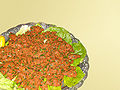 Çiğ Köfte


Ad. Transform your life with W8MD's
GLP-1 weight loss injections special from $29.99 with insurance
|
WikiMD Medical Encyclopedia |
Medical Disclaimer: WikiMD is for informational purposes only and is not a substitute for professional medical advice. Content may be inaccurate or outdated and should not be used for diagnosis or treatment. Always consult your healthcare provider for medical decisions. Verify information with trusted sources such as CDC.gov and NIH.gov. By using this site, you agree that WikiMD is not liable for any outcomes related to its content. See full disclaimer.
Credits:Most images are courtesy of Wikimedia commons, and templates, categories Wikipedia, licensed under CC BY SA or similar.
Translate this page: - East Asian
中文,
日本,
한국어,
South Asian
हिन्दी,
தமிழ்,
తెలుగు,
Urdu,
ಕನ್ನಡ,
Southeast Asian
Indonesian,
Vietnamese,
Thai,
မြန်မာဘာသာ,
বাংলা
European
español,
Deutsch,
français,
Greek,
português do Brasil,
polski,
română,
русский,
Nederlands,
norsk,
svenska,
suomi,
Italian
Middle Eastern & African
عربى,
Turkish,
Persian,
Hebrew,
Afrikaans,
isiZulu,
Kiswahili,
Other
Bulgarian,
Hungarian,
Czech,
Swedish,
മലയാളം,
मराठी,
ਪੰਜਾਬੀ,
ગુજરાતી,
Portuguese,
Ukrainian
