Osteogenesis imperfecta
| Osteogenesis imperfecta | |
|---|---|
| Characteristically blue sclerae of patient with osteogenesis imperfecta.jpg | |
| The classic blue sclerae of a person with osteogenesis imperfecta | |
| Synonyms | Brittle bone disease, Lobstein syndrome
|
| Specialty | Pediatrics, medical genetics, osteology |
| Symptoms | Bones that break easily, blue tinge to the whites of the eye, short height, loose joints, hearing loss
|
| Duration | Long term
|
| Causes | Genetic (autosomal dominant, new mutation)
|
| Diagnosis | Based on symptoms, DNA testing
|
| Treatment | Healthy lifestyle (exercise, no smoking), metal rods through the long bones
|
| Prognosis | Depends on the type |
| Frequency | 1 in 15,000 people
|
Osteogenesis Imperfecta (OI), commonly known as brittle bone disease, is a spectrum of genetic disorders primarily affecting the bones, leading to increased fragility and susceptibility to fractures.
Introduction[edit]
OI is characterized by bones that break easily, often with no apparent cause. The condition can range in severity from mild to severe, and can affect individuals differently, even within the same family.
Clinical Presentation[edit]
People with OI might have a blue tinge to the whites of the eyes (sclera), short height, loose joints, and hearing loss. The disease can also cause respiratory issues due to weak respiratory muscles and a restrictive lung disease pattern. Dental abnormalities, often termed "dentinogenesis imperfecta," can lead to discolored, brittle teeth that are prone to cavities.
Genetics[edit]
OI is caused by mutations in the genes that produce collagen, a protein crucial for bone strength. Most cases of OI are inherited in an autosomal dominant manner, meaning that an affected person has a 50% chance of passing the disorder to each of their children.
Treatment and Management[edit]
There's currently no cure for OI, but the symptoms can be managed to help individuals with OI maintain their independence. Treatments may include physical therapy, surgery, medications, and lifestyle modifications.
Complications[edit]
Possible complications of OI include cervical artery dissection and aortic dissection, which are serious conditions requiring immediate medical attention.
Epidemiology[edit]
OI affects approximately 1 in 20,000 people, making it a rare disorder. It affects both males and females of all ethnic backgrounds.
See Also[edit]

This WikiMD article can only be edited by registered and verified editors. You can log in or register.
| Diseases of collagen, laminin and other scleroproteins | ||||||
|---|---|---|---|---|---|---|
see also fibrous proteins
|
| Osteochondrodysplasias | ||||||||||||||||
|---|---|---|---|---|---|---|---|---|---|---|---|---|---|---|---|---|
|
-
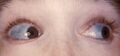 Characteristically blue sclerae of patient with osteogenesis imperfecta
 -
Osteogenesis imperfecta X-ray (clinically type IV) of left forearm
-
Osteogenesis imperfecta X-ray (clinically type IV) of spine, chest, and pelvis
-
Osteogenesis imperfecta X-ray (clinically type IV) of right arm
-
Osteogenesis imperfecta X-ray (clinically type IV) of right femur
-
Osteogenesis imperfecta
-
Osteogenesis imperfecta
-
Osteogenesis imperfecta
-
Osteogenesis imperfecta
-
Osteogenesis imperfecta
-
Osteogenesis imperfecta
-
Osteogenesis imperfecta


Medical Disclaimer: WikiMD is for informational purposes only and is not a substitute for professional medical advice. Content may be inaccurate or outdated and should not be used for diagnosis or treatment. Always consult your healthcare provider for medical decisions. Verify information with trusted sources such as CDC.gov and NIH.gov. By using this site, you agree that WikiMD is not liable for any outcomes related to its content. See full disclaimer.
Credits:Most images are courtesy of Wikimedia commons, and templates, categories Wikipedia, licensed under CC BY SA or similar.
Translate page: - East Asian
中文,
日本,
한국어,
South Asian
हिन्दी,
தமிழ்,
తెలుగు,
Urdu,
ಕನ್ನಡ,
Southeast Asian
Indonesian,
Vietnamese,
Thai,
မြန်မာဘာသာ,
বাংলা
European
español,
Deutsch,
français,
Greek,
português do Brasil,
polski,
română,
русский,
Nederlands,
norsk,
svenska,
suomi,
Italian
Middle Eastern & African
عربى,
Turkish,
Persian,
Hebrew,
Afrikaans,
isiZulu,
Kiswahili,
Other
Bulgarian,
Hungarian,
Czech,
Swedish,
മലയാളം,
मराठी,
ਪੰਜਾਬੀ,
ગુજરાતી,
Portuguese,
Ukrainian


_of_left_forearm.png)
_of_spine,_chest,_and_pelvis.png)
_of_right_arm.png)
_of_right_femur.png)


