Maids of honour tart
Maids of Honour Tart is a traditional British baked good, known for its rich, sweet flavour and delicate texture. The tart is believed to have originated in the 16th century, and is named after the Maids of Honour who served at the royal court.
History[edit]
The history of the Maids of Honour Tart is steeped in legend and tradition. It is said that the tart was first created by a cook in the household of Henry VIII. The king was so impressed by the tart that he named it after his Maids of Honour, the young women who attended the queen.
Ingredients and Preparation[edit]
The Maids of Honour Tart is made from a mixture of almond paste, sugar, butter, and egg yolk. The mixture is then spooned into a pastry shell and baked until golden. Some variations of the recipe also include currants or lemon zest for added flavour.
Cultural Significance[edit]
The Maids of Honour Tart holds a special place in British baking culture. It is often served at traditional afternoon teas, and is a popular choice for special occasions and celebrations. The tart is also a staple at many British bakeries, particularly those in the Richmond area, where it is said to have been popularised.
See Also[edit]
| British cuisine |
|---|
 |
| National cuisines |
| Regional cuisines |
| Overseas/Fusion cuisine |
| People |

-
 A selection of Maids of Honour cakes on a plate.
 -
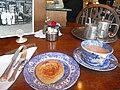 Close-up of a single Maids of Honour tart.
 -
 Chemical synthesis diagram related to Maids of Honour.


Ad. Transform your health with W8MD Weight Loss, Sleep & MedSpa

Tired of being overweight?
Get started with evidence based, physician-supervised
affordable GLP-1 weight loss injections
Now available in New York City and Philadelphia:
- Semaglutide starting from $59.99/week and up
- Tirzepatide starting from $69.99/week and up (dose dependent)
✔ Evidence-based medical weight loss ✔ Insurance-friendly visits available ✔ Same-week appointments, evenings & weekends
Learn more:
Start your transformation today with W8MD weight loss centers.
|
WikiMD Medical Encyclopedia |
Medical Disclaimer: WikiMD is for informational purposes only and is not a substitute for professional medical advice. Content may be inaccurate or outdated and should not be used for diagnosis or treatment. Always consult your healthcare provider for medical decisions. Verify information with trusted sources such as CDC.gov and NIH.gov. By using this site, you agree that WikiMD is not liable for any outcomes related to its content. See full disclaimer.
Credits:Most images are courtesy of Wikimedia commons, and templates, categories Wikipedia, licensed under CC BY SA or similar.
Translate this page: - East Asian
中文,
日本,
한국어,
South Asian
हिन्दी,
தமிழ்,
తెలుగు,
Urdu,
ಕನ್ನಡ,
Southeast Asian
Indonesian,
Vietnamese,
Thai,
မြန်မာဘာသာ,
বাংলা
European
español,
Deutsch,
français,
Greek,
português do Brasil,
polski,
română,
русский,
Nederlands,
norsk,
svenska,
suomi,
Italian
Middle Eastern & African
عربى,
Turkish,
Persian,
Hebrew,
Afrikaans,
isiZulu,
Kiswahili,
Other
Bulgarian,
Hungarian,
Czech,
Swedish,
മലയാളം,
मराठी,
ਪੰਜਾਬੀ,
ગુજરાતી,
Portuguese,
Ukrainian
