Haleem
Haleem is a popular stew originating from the Middle East. It is especially popular in the Indian subcontinent, Middle East, Central Asia and Turkey. Haleem is a unique blend of grains, meat, and spices, slow-cooked to create a thick, nutritious dish.
History[edit]
Haleem has its roots in the popular Arabian dish known as Harees. The dish was introduced to the Indian subcontinent by Arab traders and soldiers. Over time, the dish evolved and took on local flavors and ingredients, becoming what is known today as Haleem.
Ingredients and Preparation[edit]
Haleem is made by slow-cooking a mixture of barley, wheat, lentils, and meat, usually beef, mutton, or chicken. The ingredients are soaked overnight and then slow-cooked for up to eight hours, which results in a paste-like consistency. The dish is then garnished with lemon, coriander, and fried onions.
Cultural Significance[edit]
Haleem is traditionally prepared during the Islamic month of Muharram and is particularly popular during the fasting month of Ramadan. It is often served at Iftar (the meal to break the fast) due to its high nutritional value and slow energy release, which helps sustain fasting individuals through the day.
Variations[edit]
There are many regional variations of Haleem. In Pakistan, it is often garnished with ginger, lemon, and coriander, while in Bangladesh, it is usually served with naan bread. In Hyderabad, India, a variant known as Hyderabadi Haleem has gained Geographical Indication (GI) status.
See Also[edit]

-
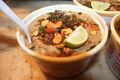 Haleem

Advertise on WikiMD — 81,000+ full articles, ~900,000 total pages, ~250 million page views. Global reach, limited time promotional rates from $1/page/day. Learn more · View stats


Translate page: - East Asian
中文,
日本,
한국어,
South Asian
हिन्दी,
தமிழ்,
తెలుగు,
Urdu,
ಕನ್ನಡ,
Southeast Asian
Indonesian,
Vietnamese,
Thai,
မြန်မာဘာသာ,
বাংলা
European
español,
Deutsch,
français,
Greek,
português do Brasil,
polski,
română,
русский,
Nederlands,
norsk,
svenska,
suomi,
Italian
Middle Eastern & African
عربى,
Turkish,
Persian,
Hebrew,
Afrikaans,
isiZulu,
Kiswahili,
Other
Bulgarian,
Hungarian,
Czech,
Swedish,
മലയാളം,
मराठी,
ਪੰਜਾਬੀ,
ગુજરાતી,
Portuguese,
Ukrainian
About WikiMD • Contact • Disclaimer • Privacy • Copyright • Site statistics
Some content and images may originate from Wikimedia Commons or Wikipedia and remain subject to their stated licenses. Unless otherwise noted, eligible WikiMD content is available under CC BY-SA 4.0.
WikiMD Wellnesspedia — Free health & wellness information for patients, students, and health professionals.

