Iftar
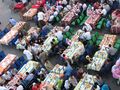
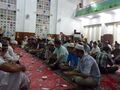
Iftar is the evening meal with which Muslims end their daily Ramadan fast at sunset. They break their fast at the time of the call to prayer for the evening prayer. This is their second meal of the day; the daily fast during Ramadan begins immediately after the pre-dawn meal of Suhur and continues during the daylight hours, ending with sunset with the evening meal of Iftar.
Etymology[edit]
The word Iftar originates from the Arabic term Iftur which means to break. It is a time when Muslims around the world break their fast and is often done as a community, with people gathering to break their fast together.
Traditions[edit]
Traditionally, a date is the first thing to be consumed during Iftar when the fast is broken. Following that, the meal typically includes water, juices, dates, salads and appetizers, one or more main dishes, and various kinds of desserts. Usually, the dessert includes sweet pastries, puddings, nuts, and fruits. The Iftar usually begins with the consumption of dates or a drink of water, following the tradition of the Islamic prophet, Muhammad, but this is not a mandatory practice.
Cultural Variations[edit]
There are many cultural variations on Iftar, depending on the country and personal preference. In places like Jordan, Iftar is often done as a community, with a large spread of food and drink. In Turkey, Iftar is often a time for people to gather with friends and family. In India, Iftar tends to be a more private affair, often shared with family.
Health Benefits[edit]
Iftar provides the body with a chance to replenish energy levels that have been depleted throughout the day due to fasting. It is important to consume foods that are rich in complex carbohydrates and protein, fruits or vegetables, and plenty of water. Not only does it provide the body with the nutrients it needs to function, but it also helps to prevent overeating later in the night.
See Also[edit]
|
Part of a series on |
|
[[File: |
|
|
|
|

| Ramadan | ||||||||
|---|---|---|---|---|---|---|---|---|
|

-
 Iftar
Iftar -
 Iftar
Iftar -
 Iftar
Iftar -
 Iftar
Iftar -
 Iftar
Iftar -
 Iftar
Iftar -
 Iftar
Iftar -
 Iftar
Iftar -
 Iftar
Iftar -
 Iftar
Iftar -
 Iftar
Iftar -
 Iftar
Iftar


.jpg)


Medical Disclaimer: WikiMD is for informational purposes only and is not a substitute for professional medical advice. Content may be inaccurate or outdated and should not be used for diagnosis or treatment. Always consult your healthcare provider for medical decisions. Verify information with trusted sources such as CDC.gov and NIH.gov. By using this site, you agree that WikiMD is not liable for any outcomes related to its content. See full disclaimer.
Credits:Most images are courtesy of Wikimedia commons, and templates, categories Wikipedia, licensed under CC BY SA or similar.
Translate page: - East Asian
中文,
日本,
한국어,
South Asian
हिन्दी,
தமிழ்,
తెలుగు,
Urdu,
ಕನ್ನಡ,
Southeast Asian
Indonesian,
Vietnamese,
Thai,
မြန်မာဘာသာ,
বাংলা
European
español,
Deutsch,
français,
Greek,
português do Brasil,
polski,
română,
русский,
Nederlands,
norsk,
svenska,
suomi,
Italian
Middle Eastern & African
عربى,
Turkish,
Persian,
Hebrew,
Afrikaans,
isiZulu,
Kiswahili,
Other
Bulgarian,
Hungarian,
Czech,
Swedish,
മലയാളം,
मराठी,
ਪੰਜਾਬੀ,
ગુજરાતી,
Portuguese,
Ukrainian

