CpG site
Detailed article on CpG sites in genetics
|
Part of a series on |
|
[[File: |
|
Key components |
|
|
|
History and topics |
|
Research |
|
|
|
Fields |
|
Personalized medicine |
|
|

A CpG site or CpG dinucleotide is a region of DNA where a cytosine nucleotide is followed by a guanine nucleotide in the linear sequence of bases along its 5' → 3' direction. The "p" in CpG refers to the phosphodiester bond between the cytosine and the guanine. CpG sites are of particular interest in the field of epigenetics because they are often involved in the regulation of gene expression.
Structure and Function[edit]
CpG sites are characterized by the presence of a cytosine base followed by a guanine base, linked by a phosphate group. These sites are often found in clusters known as CpG islands, which are regions with a high frequency of CpG sites. CpG islands are typically located near or within the promoter regions of genes and are often associated with housekeeping genes.
Methylation[edit]
One of the key features of CpG sites is their ability to undergo DNA methylation, a process where a methyl group is added to the cytosine base. Methylation of CpG sites is a crucial epigenetic modification that can influence gene expression. When CpG sites in a promoter region are methylated, the associated gene is often silenced. This mechanism is important for processes such as X-chromosome inactivation, genomic imprinting, and the suppression of transposable elements.
Role in Disease[edit]
Aberrant methylation of CpG sites is implicated in various diseases, including cancer. In many cancers, CpG islands in the promoter regions of tumor suppressor genes become hypermethylated, leading to gene silencing and contributing to tumorigenesis. Conversely, global hypomethylation can lead to genomic instability and activation of oncogenes.
CpG Islands[edit]
CpG islands are regions of the genome that have a high frequency of CpG sites. They are typically 300 to 3,000 base pairs in length and have a GC content greater than 50%. CpG islands are often found at the 5' end of genes, particularly in the promoter regions, and are usually unmethylated in normal cells, allowing for active transcription of the associated genes.
Evolutionary Considerations[edit]
CpG sites are underrepresented in the vertebrate genome due to the tendency of methylated cytosines to undergo spontaneous deamination to thymine, leading to a mutation. This process results in a lower frequency of CpG sites over evolutionary time. However, CpG islands are conserved due to their functional importance in gene regulation.
Research Techniques[edit]
Several techniques are used to study CpG methylation, including bisulfite sequencing, which allows for the detection of methylated cytosines by converting unmethylated cytosines to uracil, while leaving methylated cytosines unchanged. Other methods include methylation-specific PCR and methylated DNA immunoprecipitation.
Also see[edit]
-
 CpG vs C-G base pair
 -
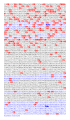 APRT CpG
 -
 APRT GpC
 -
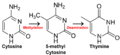 Cytosine becomes thymine
 -
 CpG island evolution
 -
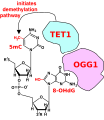 Initiation of DNA demethylation at a CpG site
 -
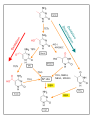 Demethylation of 5-methylcytosine
 -
 Genome Expansion


Medical Disclaimer: WikiMD is for informational purposes only and is not a substitute for professional medical advice. Content may be inaccurate or outdated and should not be used for diagnosis or treatment. Always consult your healthcare provider for medical decisions. Verify information with trusted sources such as CDC.gov and NIH.gov. By using this site, you agree that WikiMD is not liable for any outcomes related to its content. See full disclaimer.
Credits:Most images are courtesy of Wikimedia commons, and templates, categories Wikipedia, licensed under CC BY SA or similar.
Translate page: - East Asian
中文,
日本,
한국어,
South Asian
हिन्दी,
தமிழ்,
తెలుగు,
Urdu,
ಕನ್ನಡ,
Southeast Asian
Indonesian,
Vietnamese,
Thai,
မြန်မာဘာသာ,
বাংলা
European
español,
Deutsch,
français,
Greek,
português do Brasil,
polski,
română,
русский,
Nederlands,
norsk,
svenska,
suomi,
Italian
Middle Eastern & African
عربى,
Turkish,
Persian,
Hebrew,
Afrikaans,
isiZulu,
Kiswahili,
Other
Bulgarian,
Hungarian,
Czech,
Swedish,
മലയാളം,
मराठी,
ਪੰਜਾਬੀ,
ગુજરાતી,
Portuguese,
Ukrainian

