Charles Sanders Peirce
Charles Sanders Peirce (September 10, 1839 – April 19, 1914) was an American philosopher, logician, mathematician, and scientist who is sometimes known as "the father of pragmatism". He made significant contributions to a wide range of subjects, including logic, epistemology, mathematics, semiotics (the study of signs), and the philosophy of science. Peirce is also noted for his work on the logic of relations and on the theory of probability. His work has influenced a broad range of philosophical traditions, including phenomenology, existentialism, and analytic philosophy.
Biography[edit]
Charles Sanders Peirce was born in Cambridge, Massachusetts, in 1839. His father, Benjamin Peirce, was a professor of mathematics and astronomy at Harvard University, and his mother, Sarah Hunt Mills, came from a family involved in the abolitionist movement. Peirce attended Harvard University, where he showed an early interest in chemistry and philosophy. After graduating, he worked for the United States Coast and Geodetic Survey, where he developed his ideas on measurement and scientific methodology.
Philosophical Contributions[edit]
Peirce's philosophical contributions are vast and interdisciplinary. He is best known for his development of pragmatism, a philosophical movement that emphasizes the practical effects of beliefs and concepts as the key to understanding their meanings. Peirce's version of pragmatism, which he later called "pragmaticism" to distinguish it from the interpretations of others, is grounded in the idea that the meaning of any concept lies in its observable practical effects.
Semiotics[edit]
Peirce is also renowned for his work in semiotics, the study of signs and symbols. He proposed a triadic model of the sign, consisting of the sign (or representamen), the object, and the interpretant. This model has been influential in the development of modern semiotics and communication theory.
Logic and Mathematics[edit]
In the field of logic, Peirce is known for his contributions to the development of symbolic logic and for his work on the logic of relations, which laid the groundwork for modern relational databases. He also made significant contributions to mathematics, including the formulation of Peirce's law in Boolean algebra.
Legacy[edit]
Peirce's work was not widely recognized during his lifetime, and he struggled with financial instability and professional isolation. However, his ideas have gained recognition and influence in the 20th and 21st centuries, impacting a wide range of disciplines. His contributions to logic, semiotics, and philosophy continue to be studied and celebrated for their depth and originality.
Selected Works[edit]
- The Fixation of Belief (1877)
- How to Make Our Ideas Clear (1878)
- The Principles of Philosophy (1903)
See Also[edit]
 | This article about a philosopher is a stub. You can help WikiMD by expanding the page. |
-
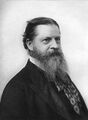 Charles Sanders Peirce
 -
 Charles Sanders Peirce's Birthplace Building
 -
 Charles Sanders Peirce in 1859
 -
 Peirce Quincuncial Projection 1879
 -
 Juliette and Charles
 -
 Charles S. Peirce House
 -
 Gravestone of Charles Sanders Peirce and Juliette Peirce
 -
 Peirce Alpha Graphs


Medical Disclaimer: WikiMD is for informational purposes only and is not a substitute for professional medical advice. Content may be inaccurate or outdated and should not be used for diagnosis or treatment. Always consult your healthcare provider for medical decisions. Verify information with trusted sources such as CDC.gov and NIH.gov. By using this site, you agree that WikiMD is not liable for any outcomes related to its content. See full disclaimer.
Credits:Most images are courtesy of Wikimedia commons, and templates, categories Wikipedia, licensed under CC BY SA or similar.
Translate page: - East Asian
中文,
日本,
한국어,
South Asian
हिन्दी,
தமிழ்,
తెలుగు,
Urdu,
ಕನ್ನಡ,
Southeast Asian
Indonesian,
Vietnamese,
Thai,
မြန်မာဘာသာ,
বাংলা
European
español,
Deutsch,
français,
Greek,
português do Brasil,
polski,
română,
русский,
Nederlands,
norsk,
svenska,
suomi,
Italian
Middle Eastern & African
عربى,
Turkish,
Persian,
Hebrew,
Afrikaans,
isiZulu,
Kiswahili,
Other
Bulgarian,
Hungarian,
Czech,
Swedish,
മലയാളം,
मराठी,
ਪੰਜਾਬੀ,
ગુજરાતી,
Portuguese,
Ukrainian

