Existentialism
Existentialism is a philosophical theory or approach that emphasizes the existence of the individual person as a free and responsible agent determining their own development through acts of the will.
Overview[edit]
Existentialism is a philosophical and cultural movement which holds that the starting point of philosophical thinking must be the individual and the experiences of the individual. It is associated with several 19th and 20th-century European philosophers who shared an emphasis on the human subject, despite profound doctrinal differences.
History[edit]
Existentialism's origins are often traced to the philosophical thought of Søren Kierkegaard and Friedrich Nietzsche. Though a variety of thinkers and writers have been associated with the movement, including Jean-Paul Sartre, Albert Camus, and Simone de Beauvoir, it is Sartre who is most often credited with being the philosophical founder of existentialism.
Key Concepts[edit]
Existentialism is characterized by a number of key concepts, including:
- Authenticity: The degree to which one is true to one's own personality, spirit, or character, despite external pressures.
- Freedom: The power or right to act, speak, or think as one wants.
- Existence precedes essence: A central claim of existentialism, which reverses the traditional philosophical view that the essence or nature of a thing is more fundamental and immutable than its existence.
- The Absurd: The conflict between the human tendency to seek inherent value and meaning in life, and the human inability to find any in a purposeless, meaningless or irrational universe.
Criticisms[edit]
Existentialism has been criticized for being overly pessimistic and for ignoring the social dimensions of human experience. Critics argue that it focuses too much on the individual and not enough on the societal and cultural influences that shape an individual's identity and experiences.
See Also[edit]
References[edit]

This WikiMD article can only be edited by registered and verified editors. You can log in or register.
-
 Sisyphus by Franz von Stuck
 -
 Jean-Paul Sartre and Simone de Beauvoir at Balzac Memorial
 -
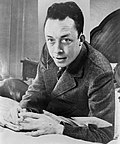 Albert Camus, Nobel Prize winner
 -
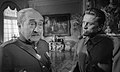 Paths of Glory
 -
 Franz Kafka's "The Trial" (Der Prozess)


Medical Disclaimer: WikiMD is for informational purposes only and is not a substitute for professional medical advice. Content may be inaccurate or outdated and should not be used for diagnosis or treatment. Always consult your healthcare provider for medical decisions. Verify information with trusted sources such as CDC.gov and NIH.gov. By using this site, you agree that WikiMD is not liable for any outcomes related to its content. See full disclaimer.
Credits:Most images are courtesy of Wikimedia commons, and templates, categories Wikipedia, licensed under CC BY SA or similar.
Translate page: - East Asian
中文,
日本,
한국어,
South Asian
हिन्दी,
தமிழ்,
తెలుగు,
Urdu,
ಕನ್ನಡ,
Southeast Asian
Indonesian,
Vietnamese,
Thai,
မြန်မာဘာသာ,
বাংলা
European
español,
Deutsch,
français,
Greek,
português do Brasil,
polski,
română,
русский,
Nederlands,
norsk,
svenska,
suomi,
Italian
Middle Eastern & African
عربى,
Turkish,
Persian,
Hebrew,
Afrikaans,
isiZulu,
Kiswahili,
Other
Bulgarian,
Hungarian,
Czech,
Swedish,
മലയാളം,
मराठी,
ਪੰਜਾਬੀ,
ગુજરાતી,
Portuguese,
Ukrainian

