Cannabigerolic acid

Cannabigerolic acid (CBGA) is a key cannabinoid compound found in the Cannabis plant. It is the precursor to the three major cannabinoid lines: tetrahydrocannabinolic acid (THCA), cannabidiolic acid (CBDA), and cannabichromenic acid (CBCA). CBGA is synthesized in the plant through the condensation of geranyl pyrophosphate and olivetolic acid.
Biosynthesis[edit]
CBGA is synthesized in the trichomes of the cannabis plant. The biosynthesis begins with the production of olivetolic acid, which is derived from the polyketide pathway. Olivetolic acid then combines with geranyl pyrophosphate in a reaction catalyzed by the enzyme geranylpyrophosphate:olivetolate geranyltransferase to form CBGA.
Once formed, CBGA can be converted into other cannabinoids through the action of specific synthase enzymes:
- THCA synthase converts CBGA into THCA, which is the precursor to tetrahydrocannabinol (THC).
- CBDA synthase converts CBGA into CBDA, which is the precursor to cannabidiol (CBD).
- CBCA synthase converts CBGA into CBCA, which is the precursor to cannabichromene (CBC).
Role in Cannabis Plant[edit]
CBGA plays a crucial role in the cannabis plant as the "mother of all cannabinoids." It is the starting point for the synthesis of other cannabinoids, which are responsible for the plant's psychoactive and medicinal properties. The concentration of CBGA in the plant can influence the overall cannabinoid profile, affecting the plant's potency and therapeutic potential.
Medical Research[edit]
Research into CBGA is ongoing, with studies exploring its potential therapeutic benefits. Preliminary research suggests that CBGA may have anti-inflammatory, antibacterial, and antioxidant properties. However, more research is needed to fully understand its effects and potential applications in medicine.
Related Pages[edit]
| Cannabis | ||||||||||||||
|---|---|---|---|---|---|---|---|---|---|---|---|---|---|---|
*
|
-
 Chemical structure of Cannabigerolic acid
 -
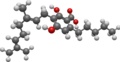 3D ball-and-stick model of Cannabigerolic acid


Medical Disclaimer: WikiMD is for informational purposes only and is not a substitute for professional medical advice. Content may be inaccurate or outdated and should not be used for diagnosis or treatment. Always consult your healthcare provider for medical decisions. Verify information with trusted sources such as CDC.gov and NIH.gov. By using this site, you agree that WikiMD is not liable for any outcomes related to its content. See full disclaimer.
Credits:Most images are courtesy of Wikimedia commons, and templates, categories Wikipedia, licensed under CC BY SA or similar.
Translate page: - East Asian
中文,
日本,
한국어,
South Asian
हिन्दी,
தமிழ்,
తెలుగు,
Urdu,
ಕನ್ನಡ,
Southeast Asian
Indonesian,
Vietnamese,
Thai,
မြန်မာဘာသာ,
বাংলা
European
español,
Deutsch,
français,
Greek,
português do Brasil,
polski,
română,
русский,
Nederlands,
norsk,
svenska,
suomi,
Italian
Middle Eastern & African
عربى,
Turkish,
Persian,
Hebrew,
Afrikaans,
isiZulu,
Kiswahili,
Other
Bulgarian,
Hungarian,
Czech,
Swedish,
മലയാളം,
मराठी,
ਪੰਜਾਬੀ,
ગુજરાતી,
Portuguese,
Ukrainian

