Δ-8-Tetrahydrocannabinol
Δ-8-Tetrahydrocannabinol (also known as delta-8-THC, Δ8-THC, and sometimes D8-THC) is a psychoactive cannabinoid found in the Cannabis plant. It is an isomer of Δ-9-THC, the compound commonly known as THC.
Chemistry[edit]
Δ-8-THC is a double bond isomer of the more common Δ-9-THC. While it may not produce the same intensity of psychoactive effects as Δ-9-THC, it is still considered psychoactive. The molecule of Δ-8-THC differs from that of the Δ-9-THC due to the location of a critical double bond. Both Δ-8 and Δ-9-THC contain a chain of carbon atoms, but Δ-8-THC contains the double bond on the 8th carbon chain, while Δ-9-THC contains the double bond on the 9th carbon chain.
Pharmacology[edit]
Δ-8-THC binds to the CB1 receptors located in the central nervous system. Δ-8-THC also has an affinity for CB2 receptors, although less is known about this binding mechanism. The CB1 receptor is responsible for mediating most of the psychotropic effects of THC.
Effects[edit]
Δ-8-THC has been reported to have similar psychoactive effects to Δ-9-THC, although the effects are reported to be less intense. These effects can include altered mood, perceptions, and cognitive functions. It is also reported to have a lower psychotropic potency than Δ-9-THC.
Medical Use[edit]
Research on the medical benefits of Δ-8-THC is still in its early stages. However, studies have suggested that it may have benefits in treating a variety of conditions such as pain, inflammation, nausea, and anxiety.
Legal Status[edit]
The legal status of Δ-8-THC varies by country and is often tied to the legal status of Cannabis. In the United States, Δ-8-THC is federally legal under the 2018 Farm Bill, as long as it is derived from hemp and contains less than 0.3% Δ-9-THC.
See Also[edit]

-
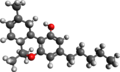 Δ-8-Tetrahydrocannabinol
 -
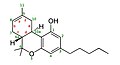 Δ-8-Tetrahydrocannabinol
 -
 Δ-9-Tetrahydrocannabinol


Medical Disclaimer: WikiMD is for informational purposes only and is not a substitute for professional medical advice. Content may be inaccurate or outdated and should not be used for diagnosis or treatment. Always consult your healthcare provider for medical decisions. Verify information with trusted sources such as CDC.gov and NIH.gov. By using this site, you agree that WikiMD is not liable for any outcomes related to its content. See full disclaimer.
Credits:Most images are courtesy of Wikimedia commons, and templates, categories Wikipedia, licensed under CC BY SA or similar.
Translate page: - East Asian
中文,
日本,
한국어,
South Asian
हिन्दी,
தமிழ்,
తెలుగు,
Urdu,
ಕನ್ನಡ,
Southeast Asian
Indonesian,
Vietnamese,
Thai,
မြန်မာဘာသာ,
বাংলা
European
español,
Deutsch,
français,
Greek,
português do Brasil,
polski,
română,
русский,
Nederlands,
norsk,
svenska,
suomi,
Italian
Middle Eastern & African
عربى,
Turkish,
Persian,
Hebrew,
Afrikaans,
isiZulu,
Kiswahili,
Other
Bulgarian,
Hungarian,
Czech,
Swedish,
മലയാളം,
मराठी,
ਪੰਜਾਬੀ,
ગુજરાતી,
Portuguese,
Ukrainian

