Hemp milk
Hemp Juice is a type of juice extracted from the hemp plant, specifically from its leaves and green parts. It is a non-psychoactive substance, meaning it does not contain significant amounts of tetrahydrocannabinol (THC), the compound responsible for the psychoactive effects associated with cannabis.
History[edit]
The use of hemp in various forms dates back thousands of years. However, the extraction and consumption of hemp juice is a relatively recent development. It emerged as part of the broader trend towards health foods and natural remedies in the late 20th and early 21st centuries.
Production[edit]
Hemp juice is produced by cold-pressing the leaves and green parts of the hemp plant. This process helps to preserve the nutritional content of the juice, which includes vitamins, minerals, and cannabinoids such as cannabidiol (CBD).
Health Benefits[edit]
Hemp juice is often consumed for its potential health benefits. These include:
- Nutritional Value: Hemp juice is rich in essential nutrients, including vitamins A, C, and E, as well as minerals like calcium, iron, and potassium.
- Antioxidant Properties: The juice contains antioxidants, which can help to protect the body against damage from harmful free radicals.
- CBD Content: Hemp juice contains CBD, a non-psychoactive cannabinoid that has been studied for its potential therapeutic effects, including pain relief, anti-inflammation, and anxiety reduction.
Legal Status[edit]
The legal status of hemp juice varies by country and region, largely due to differing laws regarding the cultivation and use of hemp. In many places, including parts of the United States and the European Union, hemp juice is legal to produce and consume, provided it meets certain regulations, such as a low THC content.
See Also[edit]

-
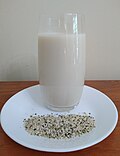 Hemp milk with hemp seeds


Medical Disclaimer: WikiMD is for informational purposes only and is not a substitute for professional medical advice. Content may be inaccurate or outdated and should not be used for diagnosis or treatment. Always consult your healthcare provider for medical decisions. Verify information with trusted sources such as CDC.gov and NIH.gov. By using this site, you agree that WikiMD is not liable for any outcomes related to its content. See full disclaimer.
Credits:Most images are courtesy of Wikimedia commons, and templates, categories Wikipedia, licensed under CC BY SA or similar.
Translate page: - East Asian
中文,
日本,
한국어,
South Asian
हिन्दी,
தமிழ்,
తెలుగు,
Urdu,
ಕನ್ನಡ,
Southeast Asian
Indonesian,
Vietnamese,
Thai,
မြန်မာဘာသာ,
বাংলা
European
español,
Deutsch,
français,
Greek,
português do Brasil,
polski,
română,
русский,
Nederlands,
norsk,
svenska,
suomi,
Italian
Middle Eastern & African
عربى,
Turkish,
Persian,
Hebrew,
Afrikaans,
isiZulu,
Kiswahili,
Other
Bulgarian,
Hungarian,
Czech,
Swedish,
മലയാളം,
मराठी,
ਪੰਜਾਬੀ,
ગુજરાતી,
Portuguese,
Ukrainian

