Benzothiazole
Benzothiazole is a heterocyclic compound that is part of the thiazole family. It is composed of a benzene ring fused to a thiazole ring, resulting in a planar structure. The compound is colorless and has a slightly unpleasant smell.
Structure and Properties[edit]
Benzothiazole has a planar structure due to the conjugation of the benzene and thiazole rings. The compound is aromatic, with the aromaticity being shared over both rings. The benzothiazole molecule is polar, with the sulfur atom carrying a partial negative charge and the nitrogen atom carrying a partial positive charge.
The compound has a molar mass of 135.19 g/mol and a density of 1.238 g/cm³. It has a boiling point of 227 °C and a melting point of 2 °C.
Synthesis[edit]
Benzothiazole can be synthesized through the condensation of 2-aminobenzenethiol (also known as o-aminothiophenol) with carbon disulfide in a basic medium. This reaction is known as the Pinner synthesis of benzothiazoles.
Applications[edit]
Benzothiazole and its derivatives have a wide range of applications in various fields. They are used in the synthesis of dyes, where they can impart a wide range of colors. They are also used in the production of fungicides and bactericides due to their antimicrobial properties.
In the pharmaceutical industry, benzothiazole derivatives are used in the synthesis of a number of drugs, including riluzole, which is used in the treatment of amyotrophic lateral sclerosis, and abafungin, an antifungal agent.
Safety[edit]
Benzothiazole is harmful if swallowed or inhaled, and it can cause skin and eye irritation. It is recommended to handle the compound with appropriate protective clothing and to use it in a well-ventilated area.
See Also[edit]

-
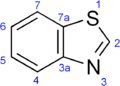 Benzothiazole numbering
 -
Benzothiazole space-filling model
-
Benzothiazole ball-and-stick model


Medical Disclaimer: WikiMD is for informational purposes only and is not a substitute for professional medical advice. Content may be inaccurate or outdated and should not be used for diagnosis or treatment. Always consult your healthcare provider for medical decisions. Verify information with trusted sources such as CDC.gov and NIH.gov. By using this site, you agree that WikiMD is not liable for any outcomes related to its content. See full disclaimer.
Credits:Most images are courtesy of Wikimedia commons, and templates, categories Wikipedia, licensed under CC BY SA or similar.
Translate page: - East Asian
中文,
日本,
한국어,
South Asian
हिन्दी,
தமிழ்,
తెలుగు,
Urdu,
ಕನ್ನಡ,
Southeast Asian
Indonesian,
Vietnamese,
Thai,
မြန်မာဘာသာ,
বাংলা
European
español,
Deutsch,
français,
Greek,
português do Brasil,
polski,
română,
русский,
Nederlands,
norsk,
svenska,
suomi,
Italian
Middle Eastern & African
عربى,
Turkish,
Persian,
Hebrew,
Afrikaans,
isiZulu,
Kiswahili,
Other
Bulgarian,
Hungarian,
Czech,
Swedish,
മലയാളം,
मराठी,
ਪੰਜਾਬੀ,
ગુજરાતી,
Portuguese,
Ukrainian


