Commissurotomy
Commissurotomy
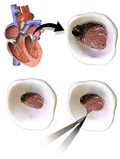
Commissurotomy is a surgical procedure that involves cutting or disrupting the commissures, which are the connections between the two hemispheres of the brain. This procedure is primarily used to treat severe cases of epilepsy that do not respond to medication. By severing the corpus callosum, the largest commissure in the brain, the spread of epileptic seizures from one hemisphere to the other can be reduced or eliminated.
History[edit]
The concept of commissurotomy dates back to the mid-20th century when neurosurgeons began exploring surgical options for treating epilepsy. The procedure gained prominence in the 1960s through the work of Roger Sperry and Michael Gazzaniga, who conducted pioneering research on split-brain patients. Their studies provided significant insights into the lateralization of brain function and the role of the corpus callosum in interhemispheric communication.
Indications[edit]
Commissurotomy is typically indicated for patients with intractable epilepsy, particularly those who experience generalized seizures that originate in one hemisphere and spread to the other. Candidates for the procedure often have not responded to antiepileptic drugs and may have a high frequency of debilitating seizures.
Procedure[edit]
The surgical procedure involves a craniotomy, where a section of the skull is removed to access the brain. The neurosurgeon then identifies and severs the corpus callosum, which is the primary pathway for communication between the left and right hemispheres. The extent of the sectioning can vary, with some procedures involving a complete callosotomy and others a partial callosotomy, depending on the patient's condition and the surgeon's assessment.
Outcomes and Effects[edit]
Commissurotomy can significantly reduce the frequency and severity of seizures in patients with severe epilepsy. However, it also results in a "split-brain" condition, where the two hemispheres of the brain cannot communicate effectively. This can lead to unique neurological phenomena, such as the inability to verbally identify objects processed by the non-dominant hemisphere.
Risks and Complications[edit]
As with any major brain surgery, commissurotomy carries risks, including infection, bleeding, and adverse reactions to anesthesia. Postoperative complications may include cognitive and sensory deficits, although these are often outweighed by the benefits of seizure reduction.
Research and Developments[edit]
Ongoing research in the field of neurology and neurosurgery continues to explore the long-term effects of commissurotomy and its impact on brain function. Advances in imaging and surgical techniques aim to improve the safety and efficacy of the procedure.
Also see[edit]
| Seizures and epilepsy | ||||||||||
|---|---|---|---|---|---|---|---|---|---|---|
|
-
 Commissurotomy

Ad. Transform your health with W8MD Weight Loss, Sleep & MedSpa

Tired of being overweight?
Special offer:
Budget GLP-1 weight loss medications
- Semaglutide starting from $29.99/week and up with insurance for visit of $59.99 and up per week self pay.
- Tirzepatide starting from $45.00/week and up (dose dependent) or $69.99/week and up self pay
✔ Same-week appointments, evenings & weekends
Learn more:
- GLP-1 weight loss clinic NYC
- W8MD's NYC medical weight loss
- W8MD Philadelphia GLP-1 shots
- Philadelphia GLP-1 injections
- Affordable GLP-1 shots NYC
|
WikiMD Medical Encyclopedia |
Medical Disclaimer: WikiMD is for informational purposes only and is not a substitute for professional medical advice. Content may be inaccurate or outdated and should not be used for diagnosis or treatment. Always consult your healthcare provider for medical decisions. Verify information with trusted sources such as CDC.gov and NIH.gov. By using this site, you agree that WikiMD is not liable for any outcomes related to its content. See full disclaimer.
Credits:Most images are courtesy of Wikimedia commons, and templates, categories Wikipedia, licensed under CC BY SA or similar.
Translate this page: - East Asian
中文,
日本,
한국어,
South Asian
हिन्दी,
தமிழ்,
తెలుగు,
Urdu,
ಕನ್ನಡ,
Southeast Asian
Indonesian,
Vietnamese,
Thai,
မြန်မာဘာသာ,
বাংলা
European
español,
Deutsch,
français,
Greek,
português do Brasil,
polski,
română,
русский,
Nederlands,
norsk,
svenska,
suomi,
Italian
Middle Eastern & African
عربى,
Turkish,
Persian,
Hebrew,
Afrikaans,
isiZulu,
Kiswahili,
Other
Bulgarian,
Hungarian,
Czech,
Swedish,
മലയാളം,
मराठी,
ਪੰਜਾਬੀ,
ગુજરાતી,
Portuguese,
Ukrainian
