Epilepsy in children
Epilepsy in children is a neurological disorder characterized by recurrent, unprovoked seizures. It is one of the most common chronic neurological disorders in children, affecting approximately 0.5-1% of the population. The condition can have a significant impact on a child's life, affecting their development, learning, behavior, and overall quality of life.
Etiology[edit]
The cause of epilepsy in children is often unknown, but it can be linked to a variety of factors. These include genetic predisposition, brain malformations, neonatal seizures, febrile seizures, central nervous system infections, and traumatic brain injury. In some cases, epilepsy can be a symptom of a larger syndrome or disease, such as Rett syndrome, Tuberous sclerosis, or Dravet syndrome.
Diagnosis[edit]
Diagnosis of epilepsy in children is based on the child's medical history, a physical and neurological examination, and the results of diagnostic tests. These tests may include an electroencephalogram (EEG), which records the electrical activity of the brain, and imaging studies such as magnetic resonance imaging (MRI) or computed tomography (CT) scans.
Treatment[edit]
Treatment for epilepsy in children aims to control seizures, prevent complications, and enable the child to lead a normal life. This may involve the use of antiepileptic drugs, ketogenic diet, vagus nerve stimulation, or in severe cases, epilepsy surgery. The choice of treatment depends on the type of seizures, the child's age, the cause of epilepsy, and the child's overall health.
Prognosis[edit]
The prognosis for children with epilepsy varies widely. Some children outgrow their seizures as they get older, while others may have lifelong epilepsy. The prognosis is generally better for children who have a known cause of epilepsy, respond well to treatment, and have a normal neurological examination.
See also[edit]
 | This article about a neurology is a stub. You can help WikiMD by expanding the page. |
 | This medical article is a stub. You can help WikiMD by expanding the page. |
Epilepsy in children[edit]
-
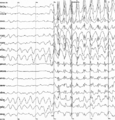 Spike-waves
 -
 EEG Image

.png)

Medical Disclaimer: WikiMD is for informational purposes only and is not a substitute for professional medical advice. Content may be inaccurate or outdated and should not be used for diagnosis or treatment. Always consult your healthcare provider for medical decisions. Verify information with trusted sources such as CDC.gov and NIH.gov. By using this site, you agree that WikiMD is not liable for any outcomes related to its content. See full disclaimer.
Credits:Most images are courtesy of Wikimedia commons, and templates, categories Wikipedia, licensed under CC BY SA or similar.
Translate page: - East Asian
中文,
日本,
한국어,
South Asian
हिन्दी,
தமிழ்,
తెలుగు,
Urdu,
ಕನ್ನಡ,
Southeast Asian
Indonesian,
Vietnamese,
Thai,
မြန်မာဘာသာ,
বাংলা
European
español,
Deutsch,
français,
Greek,
português do Brasil,
polski,
română,
русский,
Nederlands,
norsk,
svenska,
suomi,
Italian
Middle Eastern & African
عربى,
Turkish,
Persian,
Hebrew,
Afrikaans,
isiZulu,
Kiswahili,
Other
Bulgarian,
Hungarian,
Czech,
Swedish,
മലയാളം,
मराठी,
ਪੰਜਾਬੀ,
ગુજરાતી,
Portuguese,
Ukrainian

