Tail


Tail[edit]
The tail is a distinct and typically flexible appendage attached to the posterior or base of the torso in numerous animals. Notably seen in vertebrates, certain invertebrates also exhibit tail-like structures. Tails have evolved to serve a multitude of functions, ranging from aiding locomotion in aquatic species to acting as a form of communication in social animals. Objects or organisms exhibiting a tail-like structure can be termed as "caudate", and any part of the body near or associated with the tail is described as "caudal".
Anatomy[edit]
Tails are analogous to the sacrum and coccyx in mammals, reptiles, and birds. Some invertebrates, such as scorpions, springtails, as well as snails and slugs, possess structures that can be considered as tail-like.
Function[edit]
Locomotion[edit]
In aquatic environments, tails in creatures like fish serve as vital propellers for movement.
Balance[edit]
Animals like cats and kangaroos utilize their tails to maintain equilibrium. Additionally, certain species such as New World monkeys and opossums possess prehensile tails, allowing them to latch onto objects like tree branches.
Social Signaling[edit]
Tails play a role in animal communication. Deer, for instance, flash the white underside of their tails as a danger signal, while canids, including dogs, convey emotions via tail position and movement.
Defensive Mechanisms[edit]
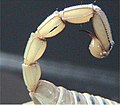
Certain species possess tails equipped with armor or venom, such as scorpions. Some lizards can autonomously shed their tails to divert predators, allowing them to escape. These cast tails can regenerate, although the color might differ from the original.
Avian Adaptations[edit]
Bird tails, terminating in long feathers known as rectrices, aid in steering and balance during flight. Several bird species flaunt modified tail feathers for courtship rituals, like the peafowl. Others, such as woodpeckers, use their tails as supports against tree surfaces.
Grazing Animals[edit]
Tails in animals like horses serve dual purposes: deterring insects and conveying the creature's mental or physical state.
Types[edit]
- Scut: A short, erect tail, commonly found in animals like hares, rabbits, and deer.
- Prehensile Tail: A tail capable of grasping objects, seen in species like monkeys, rats, and in the adaptive bodies of snakes.
Human Tails[edit]
Although adults lack an external tail, human embryos exhibit a tail accounting for roughly one-sixth of their size. As the embryo matures into a fetus, this tail gets absorbed. This remnant of our evolutionary past is deemed a vestigial structure. Occasionally, children are born with a "soft tail" comprising muscles, blood vessels, and nerves. Some of these tails have even shown to contain cartilage or vertebrae.
Tail Bone[edit]
Humans retain a vestigial tail bone called the coccyx, situated at the base of the spine and connected to the pelvis. Composed of typically four fused vertebrae, it remains internal and doesn't manifest externally.
Gallery[edit]
-
-
 Pig (Sus domestica)
 -
 Glyptodon (Glyptodon asper)
 -
 Longhorn cowfish (Lactoria cornuta)
 -
 Grévy's zebra (Equus grevyi)
 -
 Polo pony (Equus ferus caballus)
 -
 American alligator (Alligator mississipiensis)
 -
 Hippopotamus (Hippopotamus amphibius)


.006_-_Aquarium_Finisterrae.JPG)


See Also[edit]
 | |
|---|---|
 |
 |
| Anatomy and morphology | ||||||||||
|---|---|---|---|---|---|---|---|---|---|---|
|
Ad. Transform your health with W8MD Weight Loss, Sleep & MedSpa

Tired of being overweight?
Special offer:
Budget GLP-1 weight loss medications
- Semaglutide starting from $29.99/week and up with insurance for visit of $59.99 and up per week self pay.
- Tirzepatide starting from $45.00/week and up (dose dependent) or $69.99/week and up self pay
✔ Same-week appointments, evenings & weekends
Learn more:
- GLP-1 weight loss clinic NYC
- W8MD's NYC medical weight loss
- W8MD Philadelphia GLP-1 shots
- Philadelphia GLP-1 injections
- Affordable GLP-1 shots NYC
|
WikiMD Medical Encyclopedia |
Medical Disclaimer: WikiMD is for informational purposes only and is not a substitute for professional medical advice. Content may be inaccurate or outdated and should not be used for diagnosis or treatment. Always consult your healthcare provider for medical decisions. Verify information with trusted sources such as CDC.gov and NIH.gov. By using this site, you agree that WikiMD is not liable for any outcomes related to its content. See full disclaimer.
Credits:Most images are courtesy of Wikimedia commons, and templates, categories Wikipedia, licensed under CC BY SA or similar.
Translate this page: - East Asian
中文,
日本,
한국어,
South Asian
हिन्दी,
தமிழ்,
తెలుగు,
Urdu,
ಕನ್ನಡ,
Southeast Asian
Indonesian,
Vietnamese,
Thai,
မြန်မာဘာသာ,
বাংলা
European
español,
Deutsch,
français,
Greek,
português do Brasil,
polski,
română,
русский,
Nederlands,
norsk,
svenska,
suomi,
Italian
Middle Eastern & African
عربى,
Turkish,
Persian,
Hebrew,
Afrikaans,
isiZulu,
Kiswahili,
Other
Bulgarian,
Hungarian,
Czech,
Swedish,
മലയാളം,
मराठी,
ਪੰਜਾਬੀ,
ગુજરાતી,
Portuguese,
Ukrainian
