Anatomical plane
-
 Anatomical planes labeled
 -
 Anatomical plane
 -
 Anatomical plane
 -
 Anatomical plane


Anatomical plane
An anatomical plane is a hypothetical plane used to transect the human body, in order to describe the location of structures or the direction of movements. These planes are used in anatomy to provide a common point of reference for describing the human body.
Types of Anatomical Planes
There are three primary anatomical planes:
Sagittal Plane
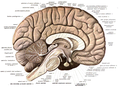
The sagittal plane is a vertical plane that divides the body into right and left parts. If the plane runs directly down the middle of the body, it is called the median plane or midsagittal plane. If it is offset from the midline, it is referred to as a parasagittal plane.
Coronal Plane
The coronal plane, also known as the frontal plane, is a vertical plane that divides the body into anterior (front) and posterior (back) sections. This plane is perpendicular to the sagittal plane and runs parallel to the coronal suture of the skull.
Transverse Plane
The transverse plane, also known as the horizontal plane or axial plane, divides the body into superior (upper) and inferior (lower) parts. This plane is perpendicular to both the sagittal and coronal planes.
Oblique Planes
In addition to the primary planes, there are oblique planes, which are any planes that do not align with the standard anatomical planes. These planes can be at any angle and are often used in medical imaging to provide a more comprehensive view of the body.
Importance in Medical Imaging
Anatomical planes are crucial in medical imaging techniques such as MRI and CT scans, where images are often taken in slices along these planes. Understanding these planes allows healthcare professionals to accurately interpret images and diagnose conditions.
Related pages
| Anatomy and morphology | ||||||||||
|---|---|---|---|---|---|---|---|---|---|---|
|
Medical Disclaimer: WikiMD is for informational purposes only and is not a substitute for professional medical advice. Content may be inaccurate or outdated and should not be used for diagnosis or treatment. Always consult your healthcare provider for medical decisions. Verify information with trusted sources such as CDC.gov and NIH.gov. By using this site, you agree that WikiMD is not liable for any outcomes related to its content. See full disclaimer.
Credits:Most images are courtesy of Wikimedia commons, and templates, categories Wikipedia, licensed under CC BY SA or similar.
Translate this page: - East Asian
中文,
日本,
한국어,
South Asian
हिन्दी,
தமிழ்,
తెలుగు,
Urdu,
ಕನ್ನಡ,
Southeast Asian
Indonesian,
Vietnamese,
Thai,
မြန်မာဘာသာ,
বাংলা
European
español,
Deutsch,
français,
Greek,
português do Brasil,
polski,
română,
русский,
Nederlands,
norsk,
svenska,
suomi,
Italian
Middle Eastern & African
عربى,
Turkish,
Persian,
Hebrew,
Afrikaans,
isiZulu,
Kiswahili,
Other
Bulgarian,
Hungarian,
Czech,
Swedish,
മലയാളം,
मराठी,
ਪੰਜਾਬੀ,
ગુજરાતી,
Portuguese,
Ukrainian
