Pan dulce: Difference between revisions
CSV import Tags: mobile edit mobile web edit |
CSV import |
||
| Line 25: | Line 25: | ||
{{Bread}} | {{Bread}} | ||
{{food-stub}} | {{food-stub}} | ||
<gallery> | |||
File:Canasta_con_pan_dulce_de_la_"Fonda_Garufa"_en_la_Colonia_Condesa_en_la_Ciudad_de_México.jpg|Basket with sweet bread from "Fonda Garufa" in Condesa, Mexico City | |||
File:Pan_Dulce_or_"Sweet_Bread".jpg|Pan Dulce or "Sweet Bread" | |||
File:Pan_dulce.JPG|Pan dulce | |||
File:Concha_(pan_dulce_mexicano)_02.JPG|Concha (Mexican sweet bread) | |||
File:CuajimalpaFeria05.JPG|Cuajimalpa Feria | |||
File:Pan_Dulce,_Casa_Lupe_Market_-pink_-bread_-pastry_-gridley_(8677873659).jpg|Pan Dulce, Casa Lupe Market | |||
File:Rosca_de_reyes_en_su_caja.jpg|Rosca de reyes in its box | |||
File:Pan_de_muerto_en_Texcoco,_estado_de_México_2.JPG|Pan de muerto in Texcoco, State of Mexico | |||
</gallery> | |||
Latest revision as of 11:34, 25 February 2025
Pan dulce is a variety of sweet bread originally from Mexico and Latin America. It is a staple food item in these regions and is commonly consumed during breakfast or dinner, often accompanied by hot beverages like coffee or hot chocolate. The term "pan dulce" translates to "sweet bread" in English.
History[edit]
The tradition of baking pan dulce in Mexico dates back to the Spanish conquest in the 16th century. The Spanish introduced wheat and other baking techniques to the indigenous people, who then incorporated their own flavors and ingredients, creating a unique blend of tastes and textures found in pan dulce.
Varieties[edit]
There are numerous varieties of pan dulce, each with its own unique shape, flavor, and texture. Some of the most popular types include:
- Conchas: Named for their seashell-like appearance, conchas are round sweet breads with a sugar topping that is scored to resemble a shell.
- Empanadas: These are turnovers filled with a variety of sweet fillings, such as fruit or cream.
- Cuernos: Translating to "horns," cuernos are crescent-shaped breads that are often filled with chocolate or vanilla cream.
Cultural Significance[edit]
Pan dulce holds a significant place in Mexican culture. It is often served during special occasions and holidays, such as Day of the Dead and Christmas. It is also a common offering in Mexican bakeries, known as panaderías, where it is displayed in large glass cases for customers to choose from.
See Also[edit]
| Mexican cuisine | ||||||||||
|---|---|---|---|---|---|---|---|---|---|---|
|
| Bread | ||||||||||
|---|---|---|---|---|---|---|---|---|---|---|
|

-
 Basket with sweet bread from "Fonda Garufa" in Condesa, Mexico City
 -
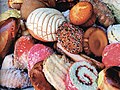 Pan Dulce or "Sweet Bread"
 -
 Pan dulce
 -
 Concha (Mexican sweet bread)
 -
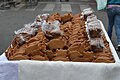 Cuajimalpa Feria
 -
 Pan Dulce, Casa Lupe Market
 -
 Rosca de reyes in its box
 -
 Pan de muerto in Texcoco, State of Mexico


_02.JPG)

.jpg)


