Frijoles negros
Frijoles negros (or black beans) are a variety of the common bean (Phaseolus vulgaris) that have a dark, almost black color. They are a staple food in many cultures, particularly in Latin America and the Caribbean, where they are often cooked with rice and other ingredients to make dishes such as Moros y Cristianos and Feijoada.
History[edit]
The black bean has been cultivated in the Americas for thousands of years. The earliest evidence of its use comes from archaeological sites in Peru and Mexico, dating back to around 7,000 years ago. The beans were a crucial part of the diet in pre-Columbian societies, along with maize and squash.
Cultivation[edit]
Black beans are grown in many parts of the world, but they are particularly common in Latin America. They are a warm-weather crop and require a long growing season to mature. The plants are typically bushy and do not require staking or trellising.
Culinary uses[edit]
Frijoles negros are used in a wide variety of dishes. They can be cooked on their own, or combined with other ingredients to make soups, stews, and casseroles. In many Latin American countries, they are a key ingredient in the national dish. For example, in Cuba, they are used to make Moros y Cristianos, a dish of black beans and rice. In Brazil, they are used in Feijoada, a hearty stew made with black beans and various types of pork.
Nutritional value[edit]
Black beans are a good source of protein, fiber, and various vitamins and minerals. They are low in fat and high in complex carbohydrates, making them a healthy choice for those looking to maintain a balanced diet.
See also[edit]
References[edit]

-
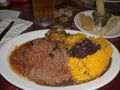 A variety of Cuban dishes including frijoles negros.
 -
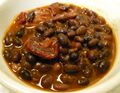 A hearty black bean stew, a staple in Cuban cuisine.
 -
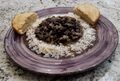 Frijoles negros served on a plate.


Advertise on WikiMD — 81,000+ full articles, ~900,000 total pages, ~250 million page views. Global reach, limited time promotional rates from $1/page/day. Learn more · View stats


Translate page: - East Asian
中文,
日本,
한국어,
South Asian
हिन्दी,
தமிழ்,
తెలుగు,
Urdu,
ಕನ್ನಡ,
Southeast Asian
Indonesian,
Vietnamese,
Thai,
မြန်မာဘာသာ,
বাংলা
European
español,
Deutsch,
français,
Greek,
português do Brasil,
polski,
română,
русский,
Nederlands,
norsk,
svenska,
suomi,
Italian
Middle Eastern & African
عربى,
Turkish,
Persian,
Hebrew,
Afrikaans,
isiZulu,
Kiswahili,
Other
Bulgarian,
Hungarian,
Czech,
Swedish,
മലയാളം,
मराठी,
ਪੰਜਾਬੀ,
ગુજરાતી,
Portuguese,
Ukrainian
About WikiMD • Contact • Disclaimer • Privacy • Copyright • Site statistics
Some content and images may originate from Wikimedia Commons or Wikipedia and remain subject to their stated licenses. Unless otherwise noted, eligible WikiMD content is available under CC BY-SA 4.0.
WikiMD Wellnesspedia — Free health & wellness information for patients, students, and health professionals.

